
Most users struggle with contact bounce and premature failure because they treat a Micro Switch as a simple button. This guide breaks down the internal physics to help you achieve industrial-grade reliability.
The Internal Mechanics of Snap-Action Reliability
At the heart of every Micro Switch is the snap-action mechanism. Unlike a standard light switch that moves as slowly as your finger does, a Micro Switch uses stored energy to snap the contacts across a gap at high speeds, regardless of how slow the physical input is.
Understanding the Over-Center Spring Principle
The magic happens thanks to a flat, trifurcated spring. When you press the plunger, you are not moving the contacts directly; you are tensioning a spring. Once that spring reaches a specific geometric point—the over-center point—it flips instantly to the other side.
- Practical Tip: To maximize switch life, ensure your actuator is not over-traveling and putting undue stress on this internal spring. Always leave a 0.1mm buffer beyond the operating point.
- Selection Step: If your application involves slow-moving cams, a snap-action switch is mandatory. A slow-break switch would cause an electrical arc that melts the contacts.
Analyzing Contact Material and Plating
Not all clicks are created equal. The material on the tiny contact dots determines the switch’s electrical destiny.
- Silver Contacts: The gold standard for power applications (1A to 25A). They handle the heat of an arc well but require a wiping action or high voltage to break through surface oxidation.
- Gold-Plated Contacts: Essential for dry circuits (logic levels below 100mA). Gold does not oxidize, ensuring your PLC or Arduino always sees the signal.
- Checklist for Selection:
- Is the current > 100mA? Use Silver.
- Is this a logic signal for a microcontroller? Use Gold.
- Is the environment corrosive? Look for sealed (IP67) housings.
Technical Specifications for Precision Integration
To master the Micro Switch, you have to speak the language of the datasheet. These metrics define whether your mechanism will work or fail.
Navigating Operating Force and Release Force
Operating Force (OF) is how hard you must press to trigger the snap, while Release Force (RF) is the push back that resets the switch.
- Design Solution: If you are building a delicate sensor, you need a Low OF switch with a long lever. This multiplies the mechanical advantage, allowing a feather-light touch to trigger the snap.
- Red Flag: If your RF is too low, gravity or slight vibrations might prevent the switch from resetting, leaving your machine stuck in an ON state.
Managing Differential Travel and Hysteresis
Differential Travel (DT) is the physical distance between the point where the switch clicks on and clicks off. This gap is actually a feature, not a bug—it’s called hysteresis.
- Stability Tip: Hysteresis prevents chatter. Without it, a vibrating machine sitting right at the trip point would turn the switch on and off 100 times a second.
- Implementation Step: When setting up a limit switch on a CNC machine, always back the axis away by at least 1.5x the DT value to ensure a clean reset before the next cycle.
Deep Dive: Beyond the Basics of Micro Switch Engineering
When you scale up to 1200 words of engineering precision, the focus shifts from “how to click” to “how to endure.” A Micro Switch is a mechanical computer that must perform millions of operations without drifting more than a few microns in its trip point.
The Physics of Arc Extinction
Every time a Micro Switch opens a circuit under load, a tiny bolt of lightning forms between the contacts. If the snap-action is too slow, this arc lingers, vaporizing the metal and creating pits. Mastering the Micro Switch means understanding that the speed of the snap is your primary defense. In DC circuits, this is even more critical because the current never passes through a zero-point, meaning the arc wants to stay alive. This is why you must strictly follow the DC voltage ratings, which are often 1/10th of the AC ratings for the same physical device.
Mechanical Fatigue and Spring Life
The beryllium copper used in the internal spring is chosen for its fatigue limit. However, heat and corrosive environments can “age” the metal. If your switch is clicking but the reset is sluggish, the spring has likely lost its temper. In high-cycle environments, choosing a switch with a higher-grade stainless steel spring or a larger physical body can dissipate heat more effectively, extending the life of the mechanism from 100,000 to 10,000,000 cycles.
Related Reading: How Long Does a Micro switch Last?
Frequently Asked Questions
Why does my Micro Switch click but not send a signal?
This is usually due to contact oxidation or carbon buildup. If you use a high-current silver switch for a low-power logic signal, there isn’t enough electrical punch to break through the microscopic layer of oxidation on the contacts.
What is the difference between NO, NC, and COM?
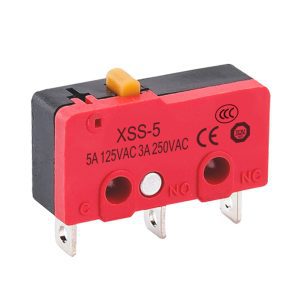
COM (Common) is where the power enters. NO (Normally Open) means the circuit is broken until you click the switch. NC (Normally Closed) means the circuit is active until you click the switch to break it.
Can I use a Micro Switch for AC and DC interchangeably?
Not always. DC arcs are harder to extinguish than AC arcs because DC doesn’t have a zero-crossing point. Always check the datasheet for specific DC ratings, which are typically much lower than the AC ratings for the same switch.
How do I stop contact bounce in my code?
Even the best snap-action switches bounce electrically for 5–20 milliseconds. In programming, you should implement a debounce timer (software delay) that ignores any additional signals for about 50ms after the first click is detected.
Why did the lever on my switch snap off?
This usually happens because of side-loading. Micro Switch plungers and levers are designed for straight-on or cam-driven movement. If your actuator hits the lever from a side angle, it creates shear stress that the plastic housing isn’t meant to handle.
Final Thoughts
Mastering the Micro Switch is about respecting the balance between mechanical movement and electrical integrity. These components are the literal bridge between the physical world and digital logic. By selecting the correct contact plating for your load, accounting for hysteresis in your mechanical design, and properly debouncing your signals, you transform a simple click into a robust, industrial-grade interface. Whether you are building a custom 3D printer or maintaining a factory floor, understanding the anatomy of the snap-action mechanism ensures that your on stays on and your off stays off, cycle after cycle, for years to come.
XURUI Engineering Team