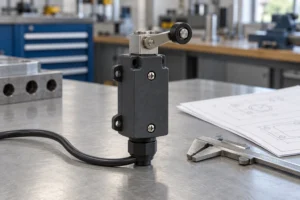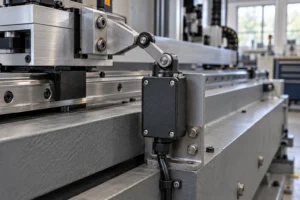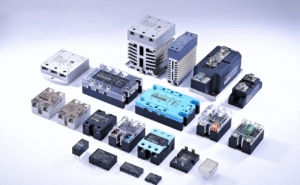
This guide moves beyond the spec sheet to explain why Hysteresis (or Differential Travel) is the “secret sauce” of system reliability. In the high-stakes world of electromechanical design, focusing solely on the “trigger point” is a common trap. The true secret to a stable system lies in mastering this “mechanical memory”—the specific distance the actuator must travel back before the contacts reset. Without this intentional gap, your machine exists in a state of chaotic indecision. Learn how to manage this “dead zone” to eliminate contact wear and ensure rock-solid precision.
The Critical Role Of Differential Travel In System Stability
To understand why a Micro Switch needs hysteresis, we must first look at what happens when it is absent. In an ideal world, a switch would turn on and off at the exact same spatial coordinate. In the real world, this would lead to a phenomenon known as “hunting” or “chattering.”
Eliminating Contact Chattering And Oscillation
Imagine a liquid level control system where a float moves a lever against a Micro Switch. As the water rises, it reaches the trip point. If the switch turned off at the exact same point it turned on, the slightest ripple on the water’s surface would cause the switch to toggle on and off hundreds of times per second.
- The Problem: This rapid cycling, or chattering, creates intense heat and electrical arcing. In a matter of hours, the silver or gold contacts inside the Micro Switch can weld shut or carbonize, leading to total system failure.
- The Solution: By selecting a Micro Switch with a defined differential travel, you create a “buffer zone.” The water must rise to point A to turn the pump off, but it must fall to point B (the reset point) before the pump turns on again. This mechanical “dead band” ensures the pump only cycles when a meaningful change has occurred.
Related Reading: Differences Between Micro Switch And Membrane Switch
Balancing Precision vs. The “Dead Zone”
There is a delicate trade-off in Micro Switch application. While hysteresis provides stability, an excessively wide differential travel creates a “dead zone” where the system is unresponsive to input.
- The Challenge: In high-speed applications like CNC limit sensing or medical laboratory equipment, a wide hysteresis window can lead to inaccurate positioning or delayed feedback loops.
- Practical Tip: To achieve high precision without sacrificing stability, engineers should look for high-quality Micro Switches with a high ratio of Reset Force (RF) to Operating Force (OF). A strong reset force ensures the internal snap-action mechanism breaks the contact bond decisively, even when the external trigger is moving at a snail’s pace.
Practical Selection Criteria For Precision Micro Switches
Selecting the right Micro Switch requires more than just glancing at a datasheet. You must interpret how the Movement Differential (MD) will interact with your specific mechanical assembly and environmental conditions.
Leveraging Actuator Geometry To Tune Hysteresis
The internal hysteresis of a Micro Switch is a fixed characteristic of its internal spring-set. However, you can effectively “tune” the system’s sensitivity by choosing the right external actuator.
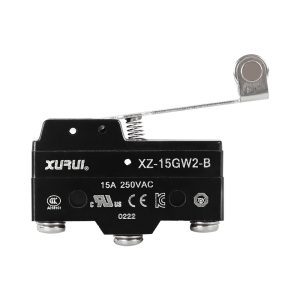
- For High Stability: Use a Long Lever Actuator. Because of the geometric relationship between the pivot and the plunger, a long lever magnifies the physical distance at the tip. This effectively increases the hysteresis at the point of contact, making the system much more resistant to vibration and minor signal noise.
- For Maximum Precision: Use a Pin Plunger. If your trigger mechanism is extremely stable and moves with high linear accuracy, the pin plunger offers the tightest differential travel. This is the gold standard for calibration and end-stop detection where every micron counts.
Accounting For Environmental Thermal Expansion
Many engineers are surprised when a Micro Switch that worked perfectly in the laboratory begins to fail in a cold warehouse or a hot engine bay. Materials expand and contract with temperature changes, and in a device as small as a Micro Switch, these changes are significant.
- Material Checklist: Standard Micro Switches use thermoplastics like PBT. For high-precision or high-heat environments, specify switches with Thermosetting Resin (Phenolic) housings. These materials offer superior dimensional stability, ensuring that the distance between the “on” and “off” points remains constant even if the ambient temperature shifts by 50°C.
Establishing The “Release Safety Zone”
A common mistake in Micro Switch integration is “under-traveling” the reset. If the object triggering the switch only moves back to the exact release position, the switch might not reset due to friction, debris, or minor mechanical play.
- The 150% Rule: To ensure a reliable reset every time, your mechanical design must allow the triggering component to retract at least 150% of the rated Differential Travel past the Release Position (RP). This “over-travel” in the reverse direction acts as a safety margin. It accounts for the inevitable wear and tear on bearings and linkages over the millions of cycles that a high-quality Micro Switch is expected to perform.
Frequently Asked Questions
Q1: Can I manually adjust the hysteresis of a Micro Switch?
A: No. The hysteresis is baked into the mechanical design of the internal snap-action spring. If you find your current switch has too much or too little “play,” you must swap it for a different model or adjust the length of your external trigger arm.
Q2: Is a “Low Hysteresis” Micro Switch always the best choice?
A: No. While “tight” specs sound impressive, a Micro Switch with very low hysteresis is prone to “contact teasing.” If the trigger lingers at the threshold, the contacts may not snap with enough force, leading to increased resistance and heat.
Q3: How does software debouncing relate to Micro Switch hysteresis?
A: Software debouncing is used to ignore the “bounce” of the spring after it hits the contact, but it cannot fix a lack of physical hysteresis. If the physical switch is chattering, the hardware will wear out regardless of how “clean” the signal looks to your computer.
Q4: Why does my Micro Switch work in the lab but fail in cold environments?
A: Cold environments increase the viscosity of internal lubricants and can cause the housing to shrink. This can effectively “trap” the plunger or reduce the reset force, preventing the Micro Switch from clicking back to the “off” position.
Q5: Does the electrical load affect the hysteresis?
A: Not the physical movement, but a high electrical load can cause “micro-welding.” If your Micro Switch has very tight hysteresis, the internal spring may not have enough force to break these tiny welds, causing the switch to stick in the “on” position.
Final Thoughts
The Micro Switch is a masterpiece of electromechanical engineering, but its effectiveness depends entirely on how the designer handles its inherent hysteresis. Precision is not just about the moment of action; it is about the reliability of the transition between states. By understanding that the “dead zone” is actually a “safety zone,” you can design systems that are not only accurate but also incredibly durable.
When you master the differential travel of a Micro Switch, you stop fighting the physics of the component and start using it to your advantage. Whether you are building a medical device, an industrial robot, or a simple limit switch for a garage door, the key to success is giving your system the “room to breathe” that only proper hysteresis can provide. Don’t just aim for the target—ensure your system knows exactly how to reset and go again.
XURUI Engineering Team