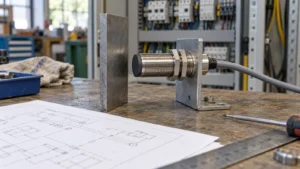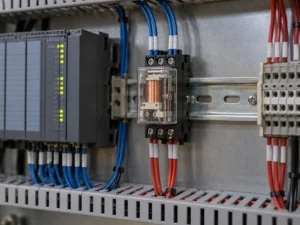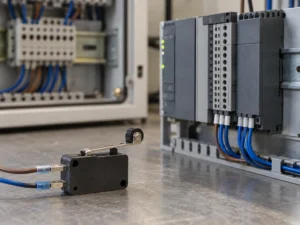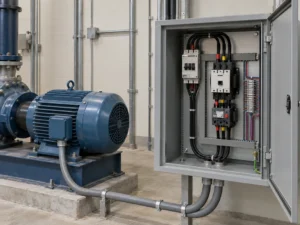
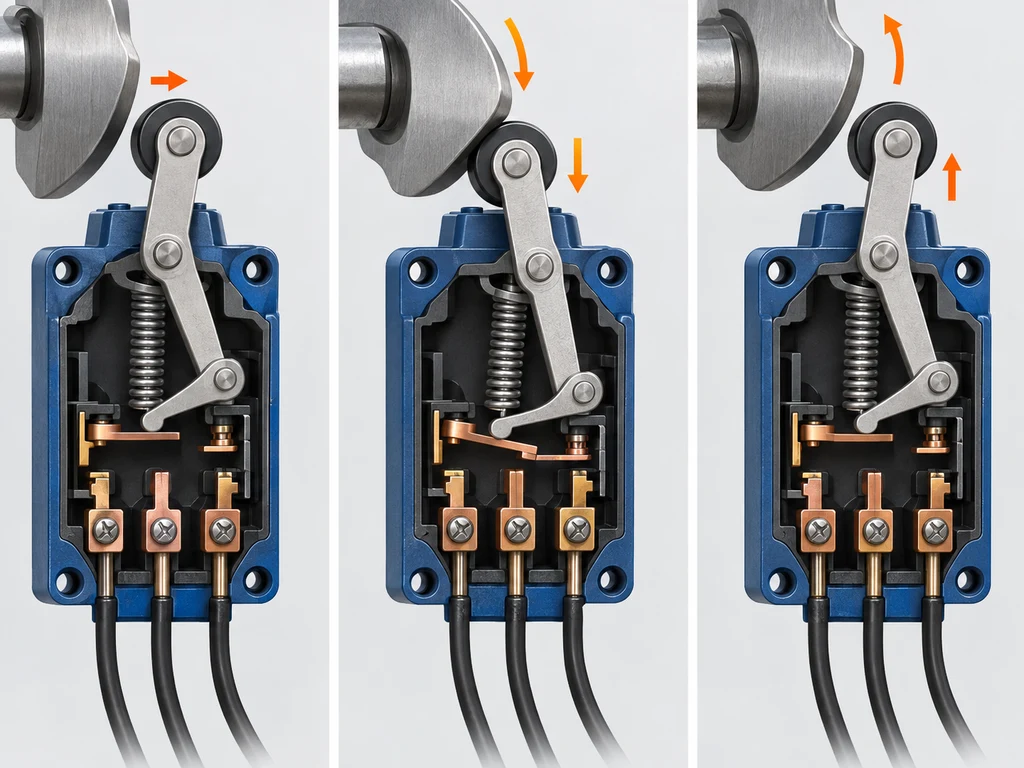
A limit switch is an electromechanical position sensor. When a target moves its actuator, mechanically linked contacts make or break an electrical connection.
This article focuses on mechanically actuated industrial limit switches. It explains their operating sequence, construction, benefits, common forms, applications, and the conditions that determine a suitable selection.
How Does a Limit Switch Work?
A limit switch works by converting controlled mechanical movement into a change of electrical contact state. A machine part, cam, door, or workpiece presses or rotates the actuator. After the actuator reaches its operating point, the internal mechanism opens a normally closed contact, closes a normally open contact, or performs both actions in a changeover arrangement.
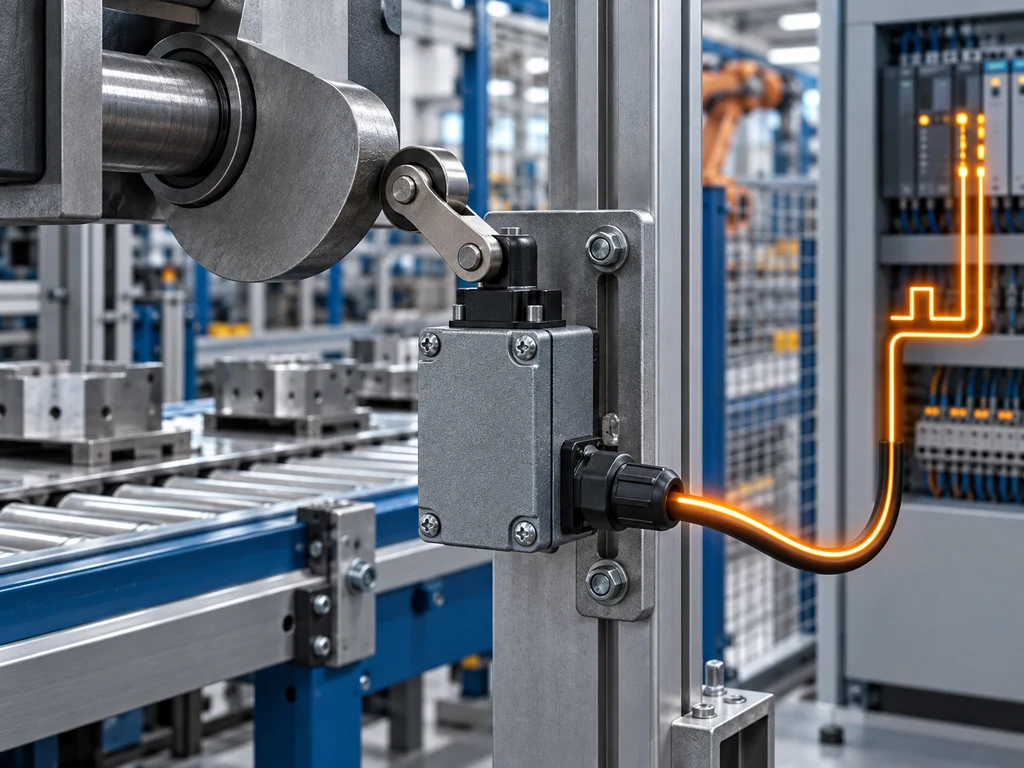
The control circuit uses that state change as a command or status signal. It may stop a motor through a contactor, change a PLC input, confirm that a valve is open, or permit the next machine step. The switch itself usually reports position; it does not perform the complete control function.
The target must provide enough travel to operate the contacts reliably without exceeding the permitted overtravel. After the target moves away, a spring-return design normally restores the actuator and contacts to their free positions. Available industrial limit switch families differ in actuator geometry, travel, contact arrangement, enclosure, and connection method.
What Are the Main Parts of a Limit Switch?
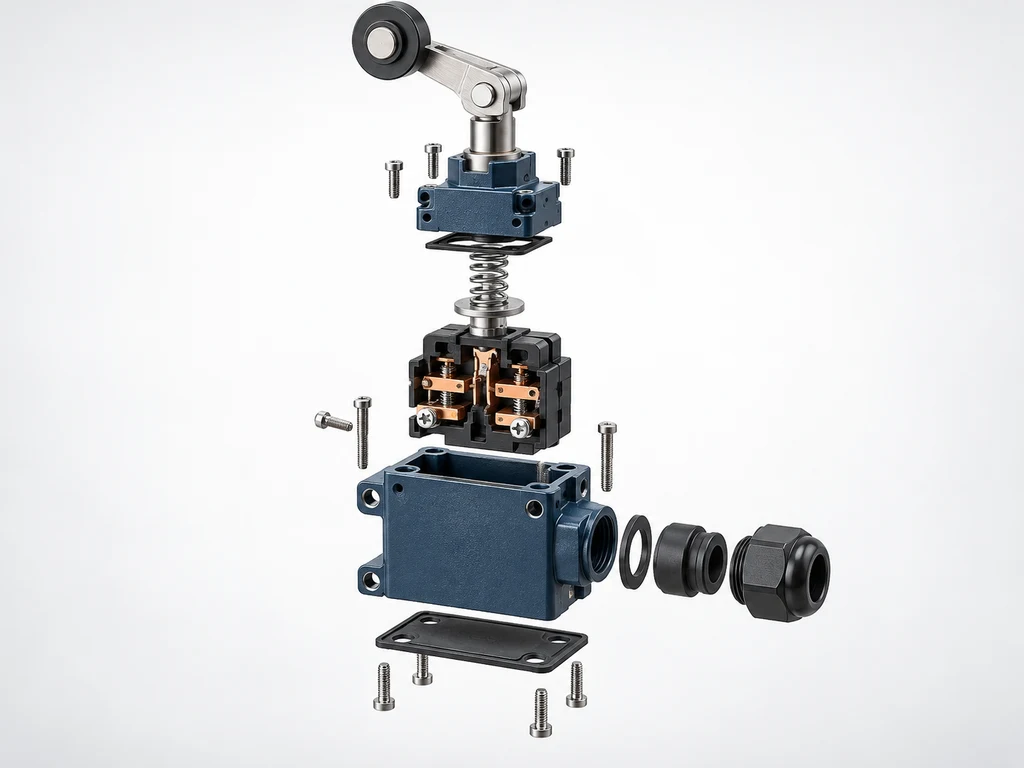
A mechanical limit switch consists of an actuator, operating head, switch body, contacts, and connection interface. These parts may be integrated or modular.
Actuator and Operating Head
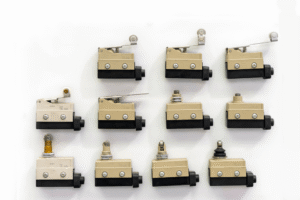
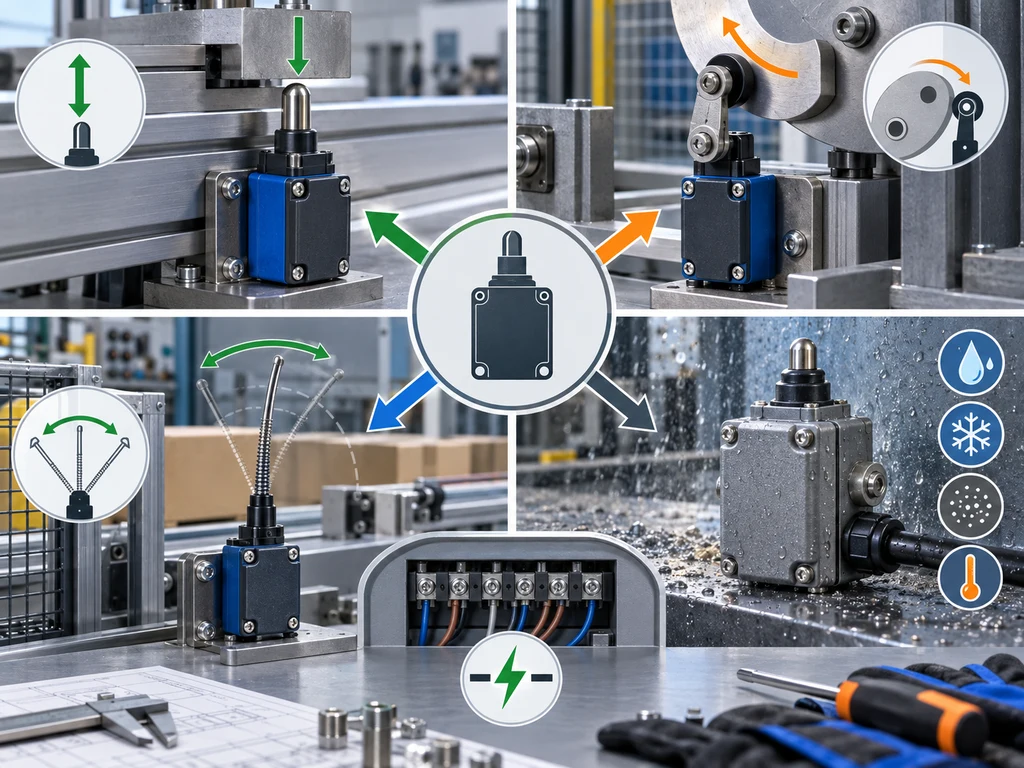
The actuator is the part that touches the target. Common forms include plain plungers, roller plungers, roller levers, rods, and flexible whiskers. Its shape must match the target’s direction, speed, approach angle, and available force.
The operating head transfers actuator movement to the switching mechanism. On some enclosed switches, the head can be repositioned to suit the mounting direction. Any permitted adjustment must follow the model drawing because incorrect head orientation or side loading can change the operating point or damage the mechanism.
Switch Body and Contact Block
The switch body supports and protects the internal mechanism. Its housing may be compact plastic, die-cast metal, or another construction selected for the expected impact and environmental exposure.
Inside the body, the contact block contains the conductive elements that make or break the circuit. The contact form may provide NO, NC, or changeover operation. Contact ratings apply under stated voltage, current, load, and switching conditions, so a headline current value alone is insufficient for selection.
Terminals and Connection Interface
The connection interface joins the switch to the control circuit. Depending on the model, it may use screw terminals, a factory-installed cable, a cordset, a conduit entry, or a plug connector.
Terminal markings and diagrams must be checked for the exact model. A three-terminal device often provides COM, NO, and NC, but terminal numbers and multi-contact arrangements vary. Cable entry, sealing, conductor size, grounding, and connector pinout also affect installation.
What Are the Advantages and Limitations of Limit Switches?
Limit switches provide direct and easy-to-observe position detection, but physical contact introduces wear and installation constraints. Their suitability depends on target motion, cycle rate, electrical load, environment, and required failure response.
| Advantages | Limitations |
| Definite switching at a mechanical position | The target must physically contact the actuator |
| Simple dry-contact interface for many control circuits | Actuators and contacts wear with repeated operation |
| Can detect targets regardless of color or optical reflectivity | Impact, side loading, or excessive overtravel can cause damage |
| NO, NC, and changeover options are widely available | Contact ratings depend on voltage and load type |
| Enclosed designs are available for demanding environments | Debris can obstruct exposed moving parts |
| Operation is usually easy to inspect and troubleshoot | Mechanical response may not suit very fast counting |
These characteristics describe the technology, not every model. Environmental protection, repeatability, mechanical life, and electrical capacity must come from the selected model’s controlled documentation.
What Are the Common Types of Limit Switches?
Limit switches are commonly classified by actuator type. Plungers suit direct linear motion, roller levers suit passing targets, flexible rods accept multi-directional contact, and rotary switches monitor angular movement.
Construction creates another classification layer. Compact or precision switches fit restricted spaces or controlled operating points. Enclosed and heavy-duty designs provide stronger housings and broader environmental options. Safety limit switches are a separate application category with features such as specified direct-opening contacts; a general-purpose switch should not be assumed to provide that function.
Because type names can describe actuator, housing, operating principle, or application, compare devices on one basis at a time. The guide to six common limit-switch types provides additional examples.
What Is a Limit Switch Used For?
A limit switch is used to confirm that an object or mechanism has reached a defined physical position. The resulting signal supports travel control, process sequencing, status indication, or position monitoring.
End-of-Travel and Position Detection
A switch can identify the end of a slide, cylinder stroke, machine axis, or movable platform. The control system then stops, reverses, or changes the permitted motion. Reliable detection requires a stable bracket, a repeatable target, adequate operating travel, and separate mechanical protection against unintended overtravel.
Machine Sequencing and Material Handling
On conveyors and production equipment, a limit switch can confirm pallet arrival, product passage, clamp position, or completion of a mechanical step. The PLC or relay logic uses this state before allowing the next operation. For counting at high speed, mechanical impact and switching frequency may make a non-contact sensor more suitable.
Door and Cover Position Detection
A limit switch can report whether an equipment door or cover is open or closed. For ordinary status monitoring, the switch and control logic must still account for misalignment, loose mounting, and broken wiring.
Personnel-safety functions require a suitable interlocking device and a validated safety-control system. An NC contact alone does not make a general-purpose limit switch safety-rated.
Position and Travel Monitoring
Valves, dampers, and actuators use limit signals to indicate travel endpoints. Elevators and hoists may require separate normal and final limit functions under applicable equipment codes.
A product platform such as this compact industrial position switch series offers plunger, roller, and lever options for different target movements. Exact ratings, dimensions, and approvals still depend on the selected model code.
How Do You Choose the Right Limit Switch?
Start with the target’s direction, speed, and approach angle. A direct-moving target may suit a plunger, while a passing cam usually favors a roller lever. Confirm the operating travel and avoid excessive impact or side loading.
Next, verify the contact form, circuit voltage, load type, current, switching frequency, and required behavior after a wire fault. A PLC input, contactor coil, solenoid, and direct power load impose different demands on the contacts.
Check the enclosure, ingress protection, temperature range, vibration, oil or chemical exposure, cable entry, dimensions, and mounting holes. If the device participates in a safety function, define the required safety architecture before selecting the switch. The limit-switch selection guide explains how actuator geometry, travel, enclosure, and contacts work together.
Final approval should use the current model datasheet and drawing, followed by a sample test in the real bracket and target path. To review a model, send the load, target movement, environment, and quantity when you contact XURUI.

Frequently Asked Questions
Is a Limit Switch a Sensor?
Yes. A mechanical limit switch is a contact-type position or presence sensor. It converts physical actuator movement into a discrete electrical contact state rather than measuring continuous distance.
What Do COM, NO and NC Mean on a Limit Switch?
COM is the common terminal. In the unactuated state, COM–NO is open and COM–NC is closed; actuation reverses these states in a typical changeover contact. This guide explains NO and NC limit-switch behavior in more detail. For safety functions, contact selection alone is insufficient; verify the switch and the complete safety-control circuit.
Does a Limit Switch Need a Separate Power Supply?
A basic mechanical dry-contact limit switch does not need separate power to move its contacts. The connected control circuit still requires its own electrical source. Illuminated, electronic, or communication-enabled models may need an additional supply.
What Is the Difference Between a Limit Switch and a Proximity Sensor?
A mechanical limit switch requires physical target contact, while a proximity sensor detects a target without contact. Limit switches provide straightforward contact outputs; proximity sensors need power and must match the target material, sensing distance, and controller input. This limit switch and proximity sensor comparison covers the practical tradeoffs.
Can a Limit Switch Be Used as a Mechanical Stop?
A standard limit switch should not serve as the machine’s hard stop. Provide a separate stop and keep actuator movement within the specified overtravel. An integrated stop-and-switch device is acceptable only when its manufacturer explicitly specifies that function.
External Sources
- OMRON Technical Guide for Limit Switches
- Eaton Limit Switch Guide
- Rockwell Automation Sensor Technology and Application Basics
- AutomationDirect: What Is a Limit Switch?