
If you’ve ever stared at a product listing for a toggle switch and wondered what “SPDT 10A 250VAC” actually means, you’re not alone. The terminology isn’t complicated once you know what each part refers to, but it’s easy to buy the wrong switch if you skip past the specs without understanding them.
This guide covers everything you need to know before buying a toggle switch: what the electrical ratings mean, how poles and throws define circuit behavior, what actuator styles are available, and a few practical questions worth asking before you place an order.
What Is a Toggle Switch?
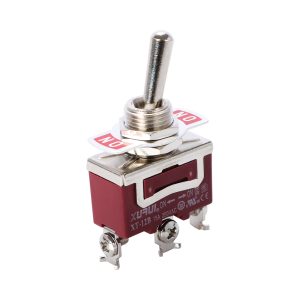
A toggle switch is a manually operated switch that uses a lever or bat-style actuator to open or close an electrical circuit. You flip it one way to turn something on, flip it back to turn it off. That basic mechanism has been used in everything from industrial control panels and marine electronics to automotive dashboards and DIY hobby projects for decades.
What makes toggle switches worth understanding in more detail is the variation underneath that simple concept. The number of circuits a single switch controls, whether it snaps to a fixed position or springs back to center, and what current and voltage it can safely handle all change significantly from one model to the next.
Related Reading: Differences Between a Rocker Switch and a Toggle Switch
Poles and Throws: The Core of How Toggle Switches Are Described
What “Poles” Means
The number of poles on a toggle switch tells you how many separate circuits the switch controls simultaneously. A single-pole switch controls one circuit. A double-pole switch controls two circuits at the same time with a single lever movement.
In practical terms, a single-pole switch is what you need when you’re switching one load on and off from a single power line. A double-pole switch is useful when you need to switch both the positive and negative lines of a DC circuit simultaneously, or both legs of a 240V AC circuit, which is common in appliances and industrial equipment.
What “Throws” Means
The number of throws tells you how many output positions the switch has. A single-throw switch connects to one output position. A double-throw switch can connect to either of two output positions, depending on which way the lever is flipped.
A single-throw toggle switch is straightforward: it’s either on or off. A double-throw switch adds routing capability. Instead of just opening or closing a circuit, it can direct the input to one of two different outputs, which is useful for reversing motor direction, switching between two power sources, or selecting between two loads.
The Four Common Configurations
SPST (Single Pole Single Throw) One circuit, two positions: on and off. The simplest toggle switch configuration. Used for basic on/off control of a single load.
SPDT (Single Pole Double Throw) One circuit, three positions: connect to output A, connect to output B, or in some versions a center-off position. Useful for switching between two circuits or as a reversing switch.
DPST (Double Pole Single Throw) Two circuits controlled simultaneously, each with a simple on/off function. Used when you need to open or close two separate circuits at the same time with one switch movement.
DPDT (Double Pole Double Throw) Two circuits, each with two possible output positions. The most versatile configuration. Commonly used in motor reversing circuits, changeover switching, and applications that require controlling two circuits simultaneously across two positions.
Electrical Ratings: What the Numbers Actually Mean
Voltage Rating
The voltage rating on a toggle switch is the maximum voltage the switch is designed to safely handle across its contacts. You’ll see ratings like 125VAC, 250VAC, 12VDC, or 28VDC listed on the spec sheet.
A switch rated for 250VAC can handle up to 250 volts of alternating current. If you’re running a 120V household circuit, that rating gives you comfortable margin. If you’re working with 24V DC control circuits, you need a switch with an appropriate DC voltage rating, since AC and DC ratings are not interchangeable. DC is generally harder on switch contacts because there’s no natural zero-crossing to help extinguish the arc at contact separation.
Current Rating
The current rating tells you how much current the switch can carry continuously and interrupt safely. Common ratings for panel-mount toggle switches range from 3A to 20A, with 6A and 10A being the most typical for general-purpose applications.
Exceeding the current rating is one of the most common reasons toggle switches fail prematurely. If your load draws 8 amps, don’t use a 6A switch. Leaving some headroom above your actual load current is good practice.
Switched Power
Some spec sheets list a maximum switched power rating in watts or VA. This combines voltage and current into a single figure and is especially useful when comparing switches across different voltage and current combinations. A switch rated for 125VAC at 10A has a switched power capacity of 1250VA, and that number helps you quickly determine whether a switch is appropriately sized.
Actuator Styles and Mounting Options
Bat Handle vs. Round Lever
The actuator style affects how the switch feels to operate and how easy it is to identify position at a glance. Bat handle actuators are the classic long toggle lever. They’re easy to grip, give a clear visual indication of on/off position, and are the most common style in industrial and marine applications.
Round lever actuators are shorter and lower-profile. They take up less panel space and are common in automotive and electronics applications where panel real estate is limited.
Maintained vs. Momentary Action
A maintained toggle switch stays in the position you flip it to. On stays on, off stays off, until you manually change it. This is the standard configuration for most on/off switching applications.
A momentary toggle switch springs back to its default position when you release it. Momentary switches are used for functions that should only activate while held, like a jog function on a motor, a test button, or a push-to-talk circuit. Some designs offer a (ON)-OFF-(ON) configuration, where both outer positions are momentary and the center is the stable state.
Panel Mount and Body Size
Toggle switches mount through a panel cutout and secure with a threaded bushing and nut. The standard cutout size for most full-size toggle switches is 12mm, though mini and sub-miniature versions use smaller cutouts. Check the panel thickness range specified by the manufacturer to make sure the bushing length is compatible with your enclosure.
Related Reading: How to Wire a Toggle Switch
Environmental Ratings and Special Versions
IP Ratings for Wet or Dusty Environments
If your toggle switch is going into an outdoor enclosure, a marine application, or anywhere with moisture or dust exposure, check the IP rating. A switch rated IP67 is dust-tight and can handle temporary immersion. A basic panel-mount switch with no IP rating isn’t designed for those conditions and will fail faster than expected.
Illuminated Toggle Switches
Illuminated versions include a small lamp or LED in the actuator that lights up when the circuit is active. These are useful on control panels where you need a quick visual status check without looking at the load itself. They come in neon and LED versions, and the lamp voltage needs to match your circuit voltage.
High-Temperature and Specialty Versions
Standard toggle switches are typically rated for operation between -25°C and +85°C. For applications near heat sources, engine compartments, or industrial ovens, look for switches with extended temperature ratings. Some versions also feature sealed bodies for resistance to vibration and shock, which matters in mobile equipment and transportation applications.
Practical Questions to Ask Before Buying
What circuit configuration do you need? Start with poles and throws. SPST for simple on/off, SPDT for switching between two paths, DPST or DPDT when you need to control two circuits simultaneously.
What are your voltage and current requirements? Match the ratings to your actual operating conditions and leave some headroom. Don’t run a 10A switch at 10A continuously.
Is the action maintained or momentary? Most on/off applications use maintained. Control and jog functions typically use momentary.
Does the environment require an IP rating? If there’s any chance of moisture, dust, or chemical exposure, spec an IP-rated version from the start.
Do you need illumination? Illuminated switches cost a bit more and require matching the lamp voltage to your circuit, but they add useful functionality on busy control panels.
Final Thoughts
Understanding ratings, poles, and throws takes most of the guesswork out of buying a toggle switch. Start with the circuit configuration you need, confirm the voltage and current ratings match your application, decide on maintained or momentary action, and check whether the environment calls for any special protection.
Get those basics right and you’ll end up with a switch that does exactly what you need it to do for a long time.
XURUI Engineering Team