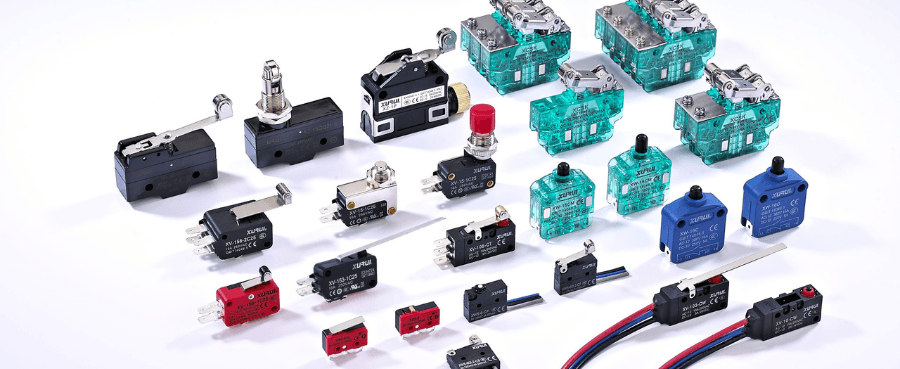
Whether you’re designing industrial automation equipment, a home appliance, or a custom electronics project, choosing the right micro switch can make or break your product’s reliability. Yet micro switches are frequently misunderstood, misapplied, or selected based on price alone, leading to premature failures, safety issues, and costly redesigns.
This guide covers everything engineers, procurement teams, and product designers need to know when selecting a micro switch: operating force, contact configuration, IP rating, electrical ratings, actuator type, and more.
What Exactly Is a Micro Switch?
The Snap-Action Mechanism Explained
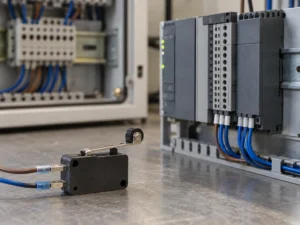
A micro switch, formally called a miniature snap-action switch, is a precision electromechanical switch that changes state very rapidly with only a small physical displacement at the actuator. Its defining feature is the snap-action mechanism: an over-center spring inside the switch causes an almost instantaneous transfer of the moving contact from one position to another, regardless of how slowly you press the actuator.
Why Snap Action Matters for Reliability
This snap action delivers two critical advantages. First, it produces a clean, bounce-minimized contact transition, reducing electrical arcing. Second, the switch’s operating point is highly repeatable, giving you the same actuation force and travel distance for millions of cycles in a row.
The 5 Electrical Parameters You Must Check Before Selecting
Most selection mistakes happen here. Do not just look at voltage and current ratings in isolation.
Rated Voltage and Current
Micro switches carry separate ratings for AC and DC. A switch rated at 15A / 250V AC may only be rated at 0.5A / 30V DC. DC is harder to interrupt because there is no zero-crossing to help extinguish the arc. If you’re switching DC loads such as motors, solenoids, or LED banks, always check the DC rating, not the AC rating.
Resistive vs. Inductive Loads
Inductive loads like motors, relays, and solenoids generate voltage spikes when switched off. These spikes can exceed the switch’s rated voltage and erode contacts far faster than a purely resistive load. If you’re switching inductive loads, derate the switch’s rated current by 50% or more, or use a snubber circuit across the load.
Contact Material
Silver alloy contacts are standard and handle most general-purpose applications. Gold-plated contacts are for low-level switching below 100mA, where even a thin oxide layer on silver would increase resistance too much to be reliable. Do not use gold-plated contacts on high-current loads because the gold burns off quickly.
Minimum Load
This is the parameter most engineers overlook. Many micro switches have a minimum switching current specified at around 100mA. Below that threshold, the contact will not self-clean through normal arcing, leading to contact chatter and unreliable switching. If you’re switching a 5mA logic signal, you need a switch specifically rated for low-level or signal switching.
Mechanical vs. Electrical Life
Mechanical life ratings (the number of cycles without load) are typically 10 to 30 million. Electrical life (with rated load) may be only 100,000 to 500,000 cycles. These are not the same number. Design your maintenance intervals around the electrical life figure.
Actuator Types and When to Use Each
The actuator determines how physical motion is translated into switch actuation. Choosing the wrong type causes either under-actuation or over-travel damage.
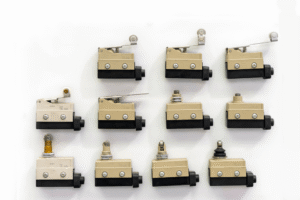
Pin Plunger
Pin plunger is the most compact option. It accepts direct axial force and is best for applications where a cam or mechanical part presses straight down onto the switch. It offers the least overtravel tolerance, so precise alignment is required.
Roller Lever
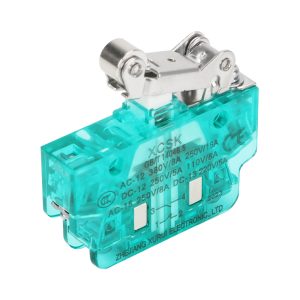
Roller lever is the most common type in automation. The roller converts lateral or angular motion into actuator depression, reduces side-loading on the plunger, and allows a wider range of approach angles. Use it for cam-driven applications.
Hinge Lever
Hinge lever (short, medium, or long) requires less force at the tip as the lever gets longer, but allows more misalignment. For delicate mechanisms or very light actuation forces, a long hinge lever is often the right choice. The tradeoff is less precise actuation position.
Simulated Roller Lever
Simulated roller lever is similar to a roller lever but uses a rounded tip instead of a rolling element. It is useful when debris or contamination could jam a roller, with only a marginal reduction in efficiency compared to a true roller.
Wire Form Lever
Wire form lever is used when the actuating mechanism is a thread, wire, or rope. It is common in textile machinery and packaging equipment.
Related Reading: How to Tell If a Micro Switch Is Bad or Faulty in Quality?
Understanding Operating Force and Differential Travel
Two mechanical parameters define how a micro switch performs in your mechanism.
Operating Force
Operating force (OF) is the force required to depress the actuator to the trip point. Standard micro switches range from roughly 25gf for light-touch models up to 1,500gf for heavy-duty industrial switches. If your actuating mechanism relies on a light spring or a soft material, a high-force switch may never reliably actuate.
Differential Travel
Differential travel (DT) is the distance the actuator travels between the operating point (where the switch trips) and the release point (where it resets). A small differential makes the switch sensitive to vibration, and it could chatter if the actuating force hovers near the trip point. A larger differential provides more hysteresis and is more stable in vibrating environments.
How These Two Parameters Work Together
These two parameters together define the precision of the application. Position sensing requires a small differential and a well-defined operating point. Overload protection often benefits from a larger differential so the switch does not chatter near threshold.
IP Ratings: Matching Protection Level to Environment
Standard vs. Sealed Micro Switches
A standard micro switch has no environmental sealing and is not suitable for use where dust, oil mist, water spray, or condensation are present. In most industrial environments, this means you need a sealed variant. IP67 and IP68 rated micro switches use elastomeric seals around the plunger and housing joints to prevent ingress. These are appropriate for food processing equipment, outdoor installations, wash-down environments, and marine applications.
IP Rating vs. Chemical Resistance
Be aware that IP rating is often confused with chemical resistance. An IP68 switch keeps water out, but the housing material may degrade when exposed to cutting fluids, hydraulic oils, or cleaning agents. Always check the chemical compatibility of the housing material, typically thermoplastic or stainless steel, against your specific environment.
Contact Configuration: NO, NC, and SPDT
Understanding the SPDT Layout
Almost every micro switch is an SPDT (Single Pole Double Throw) device, giving you access to both a normally open (NO) and a normally closed (NC) contact from a single common (C) terminal.
When to Use the NC Contact
Use the NC contact when safety requires the circuit to be active by default and open only on actuation, for example a door interlock where the circuit must break when the door opens. This way, a broken wire or failed switch also opens the circuit, creating a fail-safe condition.
When to Use the NO Contact
Use the NO contact when you want the circuit to activate only when the switch is physically pressed, which is typical for detection and counting applications. Many applications use both contacts simultaneously to drive two different circuit branches from one physical event.
Size Classes: Sub-miniature, Miniature, and Standard
Standard Body Switches
Standard (basic) switches occupy a body roughly 28 x 16 x 10mm and carry the highest electrical ratings, up to 21A on some models. These are used in appliances, industrial controls, and anywhere space is not the primary constraint.
Miniature Body Switches
Miniature switches are about half the footprint and typically rated to 5 to 10A. They are the most common type across consumer electronics, automotive, and light industrial equipment.
Sub-miniature Body Switches
Sub-miniature switches fit into very compact assemblies and are rated at 0.1A to 3A. They are common in medical devices, office equipment, and handheld instruments. Do not try to fit a sub-miniature switch into an application that needs a 10A rating. The physical contact size simply cannot carry that current reliably over its rated life.
Certifications: What They Actually Mean
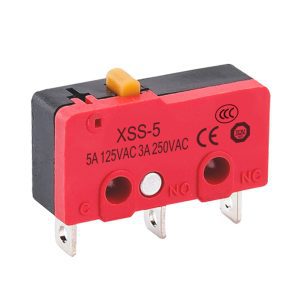
UL Recognized Component
UL Recognized Component means the switch has been evaluated by UL for use as a component within a larger product. This is different from UL Listed, which applies to end products. For most industrial and consumer applications, UL Recognized is what you need.
CE Marking
CE Marking indicates conformity with applicable EU directives. For micro switches this typically involves the Low Voltage Directive and the RoHS Directive. A CE mark without a Declaration of Conformity document is worth little, so always request the DoC.
RoHS Compliance
RoHS compliance confirms the switch is free of restricted hazardous substances. It is critical for products sold in the EU and increasingly required by buyers globally.
ENEC
ENEC is the European equivalent of UL recognition and is required for switches used in appliances sold across Europe.
Common Application Mistakes to Avoid
Applying Lateral Force to the Plunger
Micro switch plungers are designed for axial loading. Side loads accelerate wear on the plunger bushing and shift the operating point over time. If your geometry creates side loading, switch to a lever-type actuator.
Exceeding the Overtravel Limit
Every micro switch specifies a maximum overtravel beyond the operating point. Exceeding it bends the actuator lever or breaks the internal mechanism. Add a physical stop to your mechanism that prevents travel beyond the switch’s rated overtravel.
Ignoring Electrical Life in High-Cycle Applications
A switch rated for 10 million mechanical cycles may only last 200,000 cycles under its rated electrical load. For applications cycling more than 50 times per hour, calculate your expected life in hours and compare it to the electrical life specification.
Overlooking Contact Resistance Aging
Initial contact resistance is typically below 30mΩ. After significant cycling, particularly in low-current applications where self-cleaning does not occur, resistance can climb significantly. For signal-level applications, budget for higher contact resistance in your circuit design.
Choosing a Reliable Micro Switch Manufacturer
What to Look for in a Supplier
The gap between a cheap unbranded micro switch and a quality-certified one is not always visible in the part itself. It shows up six months later in field failures. When evaluating suppliers, look for documented process controls, certifications that are genuinely traceable to the part number, published electrical life test data under actual load conditions, and responsive technical support that can help you select the right variant for your application.
Why XURUI Micro Switches Are Worth Considering
XURUI Micro Switch Manufacturer covers standard, miniature, and sub-miniature body sizes with a range of actuator configurations, contact materials, and IP-rated sealed options, all backed by UL and CE certifications. Whether your application is industrial automation, home appliances, or precision instrumentation, matching the right variant to your electrical and mechanical requirements is the starting point for long-term reliability.
Final Thoughts
Selecting a micro switch is more nuanced than picking the cheapest part that physically fits. The critical variables including DC rating, load type, contact material, minimum switching current, actuator geometry, and environmental sealing each affect how long your switch will perform reliably in the field. Getting these right at the design stage is far less expensive than diagnosing field failures after production.
XURUI Engineering Team