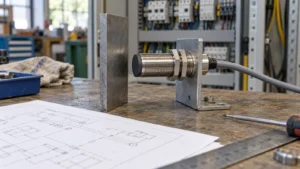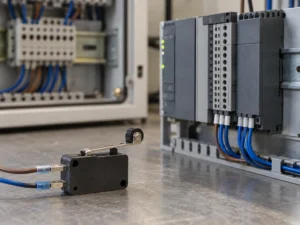

Choose a sealed limit switch by matching the IP rating, seal paths, mounting load, and cable entry to the real work area. IEC 60529 classifies enclosure protection by solid ingress and water ingress, but the rating only helps when the exact model, cable entry, actuator opening, and installation position match the exposure.
In machine use, contact contamination and actuator shift cause the real damage. A switch can still click by hand while coolant, dust, or vibration makes the PLC read the wrong state.
What Is a Sealed Limit Switch?
A sealed limit switch protects the contact area, terminals, cable entry, actuator opening, and housing joints from dust, spray, oil mist, and conductive debris. Treat “sealed” as a set of physical checks, not a loose product label.
| Seal area | What to check | Failure risk |
|---|---|---|
| Contact area | Dust, oil, coolant, and metal fines near the contact block | Chatter, sticking, unstable PLC input |
| Actuator opening | Lever shaft, plunger guide, roller, spring rod, and strike angle | Slow reset, worn guide, leak path |
| Cover gasket | Screw pressure, gasket condition, cover fit, and service damage | Dust line, oil track, corroded contact area |
| Cable entry | Gland fit, cable diameter, bend radius, and strain relief | Terminal corrosion, seal pullout |
| Terminal cover | Wiring clearance, screw pressure, trapped insulation | Moisture or metal dust near terminals |
Sealed Contact Area
The contact area is the signal point inside the limit switch. If dust, oil, coolant, or metal fines reach that area, the switch can send an unstable input even when the actuator moves correctly.
Contact logic still matters. Confirm NO vs NC limit switch behavior before treating sealing as the only reliability check.
Wet, Dusty, and Oily Work Areas
Sealed limit switches fit areas where spray, swarf, or dust reaches the body before maintenance sees the problem. Common locations include:
- conveyors and packaging lines
- CNC guards and machine tool enclosures
- lift points, end stops, and crane travel points
- outdoor fixtures with spray or dust exposure
Oil mist and coolant need extra caution because IP ratings describe dust and water tests, not every cutting fluid or cleaning chemical. For machine tools, confirm the fluid type, spray frequency, cable gland material, and seal material before approval.
What IP Rating Do Buyers Need?
The right IP rating depends on dust type, water direction, spray force, cleaning method, and mounting position. IP65 can fit dust and water jet exposure, but IP65 does not prove immersion, steam cleaning, coolant compatibility, or chemical resistance.
| Rating | Practical fit | Do not assume |
|---|---|---|
| IP65 | Dust-tight enclosure and water jet exposure under IEC 60529 test logic | Submersion, high pressure washdown, chemical resistance |
| IP67 | Temporary immersion only when the datasheet states that rating | Better spray performance in every direction |
| IP68 | Longer immersion only when the datasheet states depth and duration | General washdown approval |
| IP69K | High pressure, high temperature cleaning when product data confirms IP69K | Required for normal dust or spray jobs |
IP65 Meaning
IP65 marks dust-tight level 6 and water jet level 5 under IEC 60529 test logic. For a sealed limit switch, IP65 is a practical starting point when dust, hose splash, or nearby coolant spray can reach the housing. The rating must belong to the exact series or model. A similar body shape does not prove a similar seal.
Water Spray Limits
Water spray ratings depend on test conditions, nozzle direction, exposure time, and enclosure condition. A switch that handles spray in one mounting direction can leak if the cable entry faces upward or the cover gasket gets pinched.
Before installation:
- Keep cable loops below the entry when possible.
- Keep standing water away from the cover seam.
- Keep the actuator opening out of direct spray paths.
- Keep high pressure cleaning away unless the datasheet approves high pressure cleaning.
Datasheet Rating Proof
The datasheet should state:
- IP rating by exact model or series
- cable entry detail and gland requirement
- actuator type and operating direction
- contact rating, AC or DC use, and NO or NC logic
- temperature range and certification by series
If the page only says “sealed” without a test rating, treat that wording as a design clue, not proof. For Xurui limit switches, XZ8 has confirmed IP65 data. Other XZ series need model-level confirmation before a sealed application moves to quote.
Where Can Sealing Fail?
Sealing usually fails at moving parts, service openings, and cable strain points. Follow the real path of water, oil, dust, and vibration into the switch body.
| Failure point | What causes the leak | What to inspect |
|---|---|---|
| Actuator opening | Side load, wrong strike angle, overtravel, worn guide | Slow return, sticky plunger, loose lever, oil near the shaft |
| Cover gasket | Uneven screw pressure, cracked gasket, twisted cover | Flattened corners, rust marks, dust lines, oil tracks |
| Cable entry | Loose gland, wrong cable diameter, sharp bend, cable pull | Strain relief, gland fit, insulation pull, terminal corrosion |
| Terminal cover | Misaligned cover, trapped insulation, overtightened screws | Cover line, screw pressure, moisture near terminals |
| Housing joint | Uneven bracket, body twist, impact, poor screw engagement | Shifted body, cracked base, visible gap, worn mounting holes |
Actuator Opening
The actuator opening carries motion into the switch, which makes the opening the hardest area to seal. Lever shafts, plungers, rollers, and spring rods can pull dust or fluid toward the switch mechanism when the target strikes at the wrong angle.
Check actuator direction and overtravel before blaming the seal. Side load can wear the guide, slow the return, and open a leak path.
Cable Entry and Terminal Cover
The cable entry and terminal cover often fail after installation, not during product selection. A sealed body cannot protect terminals while the cable gland stays loose, the cable bends sharply, or insulation gets trapped under the terminal cover.
Leave a relaxed cable bend. Secure the cable before vibration reaches the gland. Recheck the cover after wiring because a clean cover line and correct screw pressure matter more than a quick hand click.
Housing Joint
A housing joint needs a flat bracket and even screw pressure because body twist can open a small gap along the cover line. Metal housing can help where frames, fixtures, guards, or workpieces may strike the switch body, but the exact model still needs separate IP proof before sealed use.
How Should Buyers Check Mounting?
Mounting decides whether the seal keeps working after the machine starts. A sealed limit switch can fail early when the bracket vibrates, the actuator overtravels, or the cable pulls the gland sideways.
| Mounting check | What good looks like | Prevents |
|---|---|---|
| Flat mounting surface | Clean, stiff, flat face with correct screw engagement | Twisted body, cracked base, gasket stress |
| Bracket vibration | Short standoff, strong bracket, thread locking method if needed | Shifted trip point, loose gland, loose terminals |
| Actuator overtravel | Cam trips the actuator before the hard stop | Bent lever, worn plunger, seal wear |
| Cable strain relief | Relaxed bend, secured cable, no pull at the entry | Open gland, terminal stress, moisture path |
| Live machine test | Jog through the trip point and check controller response | Hand-click false pass |
Flat Mounting Surface
The mounting surface should be flat, clean, and stiff enough to hold the trip point. Uneven screw pressure can twist the body and disturb the cover gasket or housing joint. Mark the installed position after alignment. A paint mark makes later movement easy to see during maintenance.
Actuator Overtravel
Actuator overtravel happens when the cam keeps pushing after the switch has already operated. Overtravel bends levers, loads plungers, and wears the actuator opening.
Set the mechanical stop outside the switch. A travel limit switch should confirm position, not absorb machine travel.
Cable Strain Relief
Cable strain relief protects the seal by keeping pulling force away from the gland and terminals. The cable should bend naturally and stay clear of moving frames, service doors, and sharp edges.
After wiring, jog the machine through the trip point and inspect the cable path. A proper limit switch testing guide should confirm input response, actuator reset, bracket movement, and cable movement under real travel.
Which Limit Switches Fit Sealed Jobs?
Xurui Switch supplies XZ series limit switches for travel limits, position confirmation, conveyors, cranes, and automation.
| Series | Confirmed fit | Typical use case | Quote check |
|---|---|---|---|
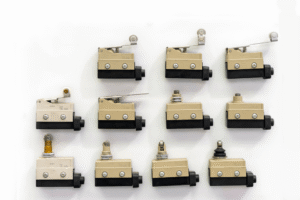
| XZ-8 (10A) Series Limit Switch | Confirmed IP65, zinc alloy plus plastic body, 10 A version | Sealed travel feedback with higher contact load inside the XZ8 family | Actuator head, wiring, certificate |
| XZ-8 (5A) Series Limit Switch | Confirmed IP65, zinc alloy plus plastic body, 5 A version | Sealed position feedback with lower contact load | Actuator head, wiring, certificate |
| XZ-9 Series Limit Switch Metal Housing Version | Die-cast metal housing variant | Exposed brackets where frames, fixtures, guards, or workpieces may hit the body | IP rating proof, actuator fit |
| XZ5, XZ7, XZ-9, XZ-93, XZ-95 | Standard XZ series for general travel and position jobs | Cleaner areas or applications where the datasheet confirms the needed seal | Model-level IP and certificate confirmation |
XZ8 Confirmed IP65 Option
XZ8 is the clearest sealed Xurui limit switch option because XZ8 has confirmed IP65 data. XZ8 uses a zinc alloy plus plastic body, supports 10 A and 5 A versions, and carries 1NO+1NC double break contact data by series.
For a model-level XZ8 check, use the XZ-8 (10A) Series Limit Switch when the application needs the 10 A version. Use XZ-8 (5A) when the sealed job has lower contact load.
Xurui’s XZ category data lists AC and DC use, -20 C to +60 C operating temperature, 1,000,000 plus mechanical operations, 300 m/s2 misoperation impact resistance, and 1000 m/s2 survival impact resistance. Contact load reaches up to 10 A/250 VAC and 6 A/380 VAC by series.
XZ-9 Metal Housing Option
XZ-9 metal housing fits impact-prone brackets where the body may contact frames, guards, fixtures, or workpieces. Do not treat metal housing as proof of water resistance because sealing still depends on the gasket, actuator opening, terminal cover, and cable entry.
Rating Confirmation Before Quote
Before quoting a sealed limit switch, confirm these items in writing: Use the limit switch manufacturer category to locate the series, then confirm IP rating, actuator type, body material, contact rating, and certificate by exact model.
| Check | What to confirm | Buyer risk |
|---|---|---|
| IP rating | Exact model rating, not family wording | Wrong seal for spray, dust, or washdown |
| Actuator | Lever, plunger, roller, rod, direction, overtravel | Broken actuator or late trip |
| Cable entry | Thread, gland, cable diameter, bend radius | Leak path and terminal stress |
| Housing | Plastic, metal, or mixed body | Cracks, impact damage, shifted trip point |
| Electrical rating | Contact load, AC or DC, NO or NC logic | Burned contact or wrong PLC input |
| Exposure | Dust, water, oil mist, coolant, cleaners | Seal material mismatch |
FAQ
Is a Sealed Limit Switch the Same as a Water-Resistant Limit Switch?
No. A sealed limit switch may be IP-rated for dust, spray, or oil mist exposure, but broad water resistance wording needs exact model data and exposure limits. Use “IP-rated” or “water-resistant variant” instead of broad water resistance claims.
Should Buyers Choose IP65, IP67, or IP69K?
Choose IP65 for dust and water jets when the datasheet confirms the rating. Choose IP67 or IP68 only for immersion needs, and choose IP69K only for high pressure, high temperature cleaning. The cleaning method matters more than the highest IP number.
Do Oil, Coolant, or Cleaning Chemicals Need a Different Rating?
Oil, coolant, and cleaning chemicals may need material compatibility proof beyond an IP rating. IP ratings focus on dust and water ingress, while fluids can swell seals, weaken plastic, or attack cable glands. Ask for seal material, cable gland data, and exposure approval before purchase.
Does Metal Housing Make a Limit Switch More Water-Resistant?
Metal housing does not automatically make a limit switch more water resistant. Metal helps with impact, stiffness, and mounting abuse, but water resistance comes from gaskets, actuator seals, terminal covers, and cable entries. Confirm the IP rating for the exact metal housing model.
When Should You Replace a Sealed Limit Switch Instead of Adjusting the Switch?
Replace a sealed limit switch when the housing cracks, the actuator sticks, the gasket leaks, terminals corrode, or the cable entry no longer holds strain relief. Adjust the bracket only when the switch body is intact and the fault comes from alignment, cam position, or overtravel.
XURUI Engineering Team