Use a momentary toggle switch when the command should stop as soon as the operator releases the lever. Jog, reset, test, and direction inputs can turn into stuck commands when the wrong switch stays on after release.
Use a maintained toggle switch when the circuit needs a stable selected state. Use a momentary toggle switch when machine logic should return to off, neutral, or center after the operator lets go.
What Is a Momentary Toggle Switch?
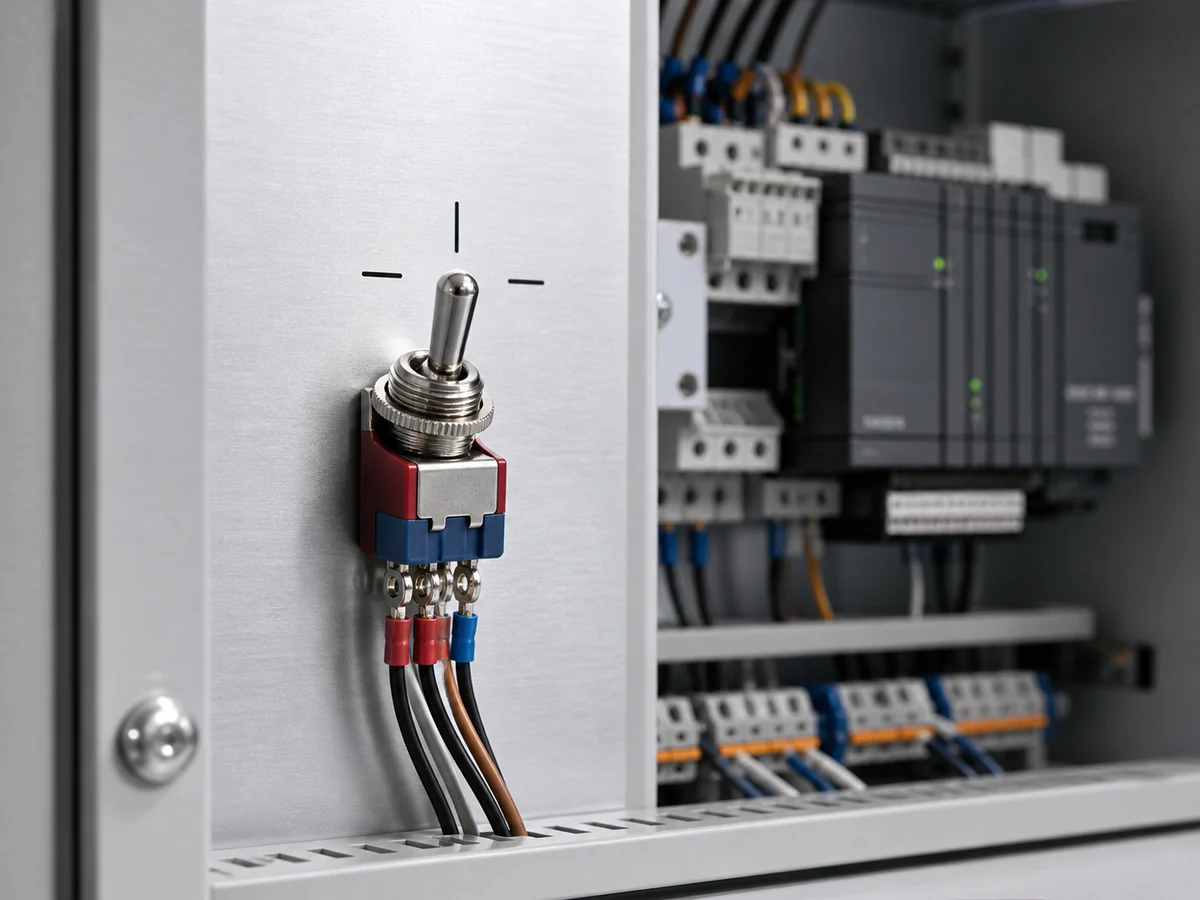
A momentary toggle switch returns to its default position after release, so the circuit receives a command only while the operator holds the lever. In panel wiring, the default state is often OFF or center OFF. A 2 position switch sends one temporary command. A 3 position switch sends left or right commands, then returns to center OFF.
Momentary describes the action, not the pole layout. A momentary switch can still be SPST, SPDT, DPST, or DPDT when the contacts support that configuration. The pole and throw choice still depends on the circuit count the lever controls.
How Is a Momentary Toggle Switch Different From a Maintained Toggle Switch?
A momentary toggle switch changes state only while the operator holds the lever. A maintained toggle switch stays in the selected position until the operator moves the lever again.
Circuit State After Release
A momentary toggle switch returns the circuit to the default state after release. A maintained toggle switch leaves the circuit in the selected state. This release behavior matters more than lever shape, because the same panel can use similar looking toggles for different control logic.
Operator Holding Behavior
Momentary action forces the operator to keep a hand on the command. This holding behavior fits jog, inching, reset, test, and temporary direction inputs because the command stops when the operator lets go. Maintained action fits lamps, mode selection, auxiliary circuits, or manual enable signals that need to stay active.
Wrong Action Risk
The wrong action type can leave motion active or drop a signal that should stay present. A maintained switch used for a jog input can keep motion active after the operator steps away. A momentary switch used for a hold circuit can release the signal and stop equipment.
Which Momentary Toggle Switch Configurations Matter?
Configuration tells the buyer what the switch does after wiring. Action type, lever positions, poles, throws, and return direction need to match the control drawing before the buyer approves the panel build.
2 Position Momentary Toggle Switches
A 2 position momentary toggle switch usually moves from OFF to ON while held, then returns to OFF after release. This layout fits one temporary command such as reset, start pulse, test input, or jog. The buyer still needs the exact contact form, because a two position lever can be SPST, SPDT, or another layout by model.
3 Position Momentary Toggle Switches
A 3 position momentary toggle switch often uses center OFF with two active directions. Markings such as (ON) OFF (ON) mean both side positions are momentary, while the center stays off. This format suits left and right jog commands, up and down movement, or forward and reverse commands routed through rated control logic.
SPST, SPDT, DPST, and DPDT Pole Layouts
Pole layout decides the circuit count that moves with the lever. SPST makes or breaks one path. SPDT selects between two paths. DPST switches two paths together. DPDT switches two changeover paths from one lever. Pole count must match the schematic, terminal count, and current path.
Center Off and Return Direction
Center OFF gives the operator a neutral home position. Return direction tells the panel what happens after hand pressure stops. In part markings, parentheses often show a momentary side, so ON OFF (ON) keeps one side maintained and makes the other side spring return. Confirm the marking before ordering, because one misplaced parenthesis changes the operator behavior.
When Should You Use a Momentary Toggle Switch?
Use a momentary toggle switch when the control signal should stop as soon as the operator releases the lever. This choice reduces unintended held commands in manual panels, service stations, and test fixtures.
Jog Control
Jog control is a common fit for momentary action. The operator holds the lever to move an axis, conveyor, small actuator, or manual setup function, then releases the lever to stop the command path. The motor or load still needs a rated drive, relay, contactor, or controller when current exceeds the switch rating.
Temporary Reset Inputs
A reset input often needs only a short signal. A momentary toggle can send that signal without leaving the reset line active. This action fits inspection, fault clearing, or setup work when the reset command should not stay applied.
Test Signals
Test signals suit momentary toggles because the test path exists only during hand pressure. A panel builder can use this action for lamp tests, signal simulation, or controller input checks. The test circuit still needs a clear label, because an unlabeled temporary command creates service risk.
Direction Control With Operator Hold
Direction control can use a 3 position momentary toggle when the operator must hold left or right, up or down, or forward or reverse. The switch should send commands to the control circuit, not carry a motor load beyond the contact rating. For wiring checks, use the same continuity logic installers need when they wire a toggle switch, then apply power only after they confirm terminal identity.
When Should You Avoid a Momentary Toggle Switch?
Avoid a momentary toggle switch when the circuit needs a stable selected state, a certified safety function, or a load above the switch rating. Momentary action cannot hold a circuit unless a relay, PLC bit, or latch holds the state after release.
Circuits That Must Stay On
Do not use a momentary toggle switch for a circuit that must stay on without operator pressure. A fan mode, light circuit, manual enable, or auxiliary supply may need maintained action. If a temporary toggle drops the signal, the panel can lose the selected function without a clear fault.
Emergency Stop and Safety Interlock Functions
Do not treat a momentary toggle switch as an emergency stop or safety interlock device. Safety functions need rated devices, wiring architecture, and validation that match the machine risk design. A standard toggle can send a control input, but a safety stop or guard function needs the proper safety circuit.
Loads Above the Switch Rating
Do not route loads above the switch rating through the toggle contacts. Motors, solenoids, lamps, and capacitive loads can draw startup current above steady current. When the load is too high, use the momentary toggle as a control input for a relay, contactor, PLC input, or drive command instead of carrying the load directly.
What Ratings and Wiring Checks Matter Before Selection?
Selection starts with the circuit, not the handle. Match load type, current, terminals, cutout, and rear space before choosing the part number.
| Check | What to verify | Failure risk |
|---|---|---|
| Load type | AC or DC rating for the exact circuit | Contact arcing or short contact life |
| Current | Running current plus inrush | Welded, overheated, or worn contacts |
| Terminal | Solder, screw, or quick-connect fit | Loose wiring or slow assembly |
| Panel fit | Bushing, cutout, depth, and wire bend | Mounting rework or cramped service access |
The same toggle switch selection checks apply when a buyer compares momentary and maintained toggle options.
AC and DC Load Type
AC and DC ratings are not interchangeable. AC current crosses zero during each cycle, which helps contacts break the arc. DC current can hold an arc longer. If the datasheet gives only an AC rating, the buyer should not assume the same current applies to DC.
Contact Rating and Inrush Current
Contact rating has to cover voltage, current, load type, and duty cycle. Inrush current is the hidden risk because a load can surge during startup even when running current looks small. If the contact rating is close to the load demand, move the power load to a relay or contactor and let the toggle switch send only the command.
Solder, Screw, and Quick Connect Terminals
Terminal style changes assembly and maintenance. Solder terminals save space in compact panels. Screw terminals help service teams remove and refit wires. Quick-connect terminals speed repeat builds when the harness uses matching crimp terminals. Loose or mismatched terminals create heat, intermittent signals, and field rework.
Panel Cutout and Rear Clearance
Panel cutout is only the front panel check. Rear clearance also has to fit the switch body, terminal angle, insulation sleeve, jumper wire, and bend radius. A switch can fit the hole and still fail the build when the cabinet door, nearby DIN rail, or harness blocks the terminals.
How Should Buyers Match XURUI XT or MTS to the Application?
For buyers comparing panel mounted toggles from a toggle switch manufacturer, XURUI XT and MTS selection should start with action type, mounting size, contact rating, environment, and sample verification.
Momentary or Maintained Action by Part Number
Match the part number to the required action before checking price or lead time. XURUI XT data includes hand-reset and auto-reset options, with auto-reset tied to momentary control needs by model. Ask for the part marking and datasheet when the circuit depends on (ON), OFF, or maintained ON behavior.
XT and MTS Mounting Sizes
XT uses a 12 mm bushing for standard panel mounting, while the MTS sub-series uses a 6 mm bushing for smaller panels. The smaller bushing can help compact controls, but the buyer still needs to check lever clearance, panel thickness, terminal access, and wire bend space.
3A to 15A Contact Ratings by Model
XURUI XT contact ratings run from 3A to 15A at 125 to 250VAC by model. This range covers signal circuits and small panel loads when the exact part number fits the load. Do not copy the 15A rating onto every XT or MTS part, because rating changes by model.
Rubber Boot or IP Rated Model Option
Selected XURUI XT models support IP-rated sealing or rubber boot caps for splash and dust exposure. The bare switch is not automatically sealed. Choose a boot, cap, or IP-rated model when the panel sees coolant mist, dust, oil, or outdoor moisture, then confirm the exact option in the datasheet.
Sample Check Before Bulk Orders
Sample testing catches wrong action, wrong terminal, and wrong panel fit before these errors become a batch problem. XURUI has built industrial control switches since 2002 and supplies quote-based B2B orders through XURUI Switch. For a momentary toggle order, sample testing should verify the lever return, terminal continuity, bushing fit, rear clearance, and real load behavior before bulk purchase.
Before issuing an RFQ, list the exact action, pole layout, throw pattern, contact rating, terminal style, bushing size, and boot or IP-rated option by model.
FAQ
Is a momentary toggle switch the same as a push button?
A momentary toggle switch is not the same as a push button, although both can send temporary commands. A toggle uses a lever that moves to a side position, while a push button moves straight in. Toggle action gives the operator a visible left/right or up/down position.
What does (ON) OFF (ON) mean on a toggle switch?
(ON) OFF (ON) means both ON positions are momentary and the center position is OFF. The parentheses show spring return. The operator can hold either side to send a command, then the lever returns to center OFF after release.
Can a momentary toggle switch control a latching relay?
A momentary toggle switch can control a latching relay when the relay coil voltage, input circuit, and wiring diagram support pulse commands. The toggle sends the temporary input, and the relay holds the output state. The relay, not the toggle lever, keeps the circuit latched.
Do momentary toggle switches need debounce for PLC or controller inputs?
Momentary toggle switches may need debounce when a PLC or controller input reacts to contact bounce. A controller can filter short bounce in software or input settings when the input module supports that setting. Fast counters, edge triggers, and sensitive logic need a checked debounce setting before the panel ships.
Can you replace a maintained toggle switch with a momentary toggle switch?
You can replace a maintained toggle switch with a momentary toggle switch only when the control circuit needs a temporary command instead of a held state. A direct swap can drop a circuit that needs to stay on. Check the schematic, contact rating, action marking, terminal layout, and operator label first.
XURUI Engineering Team