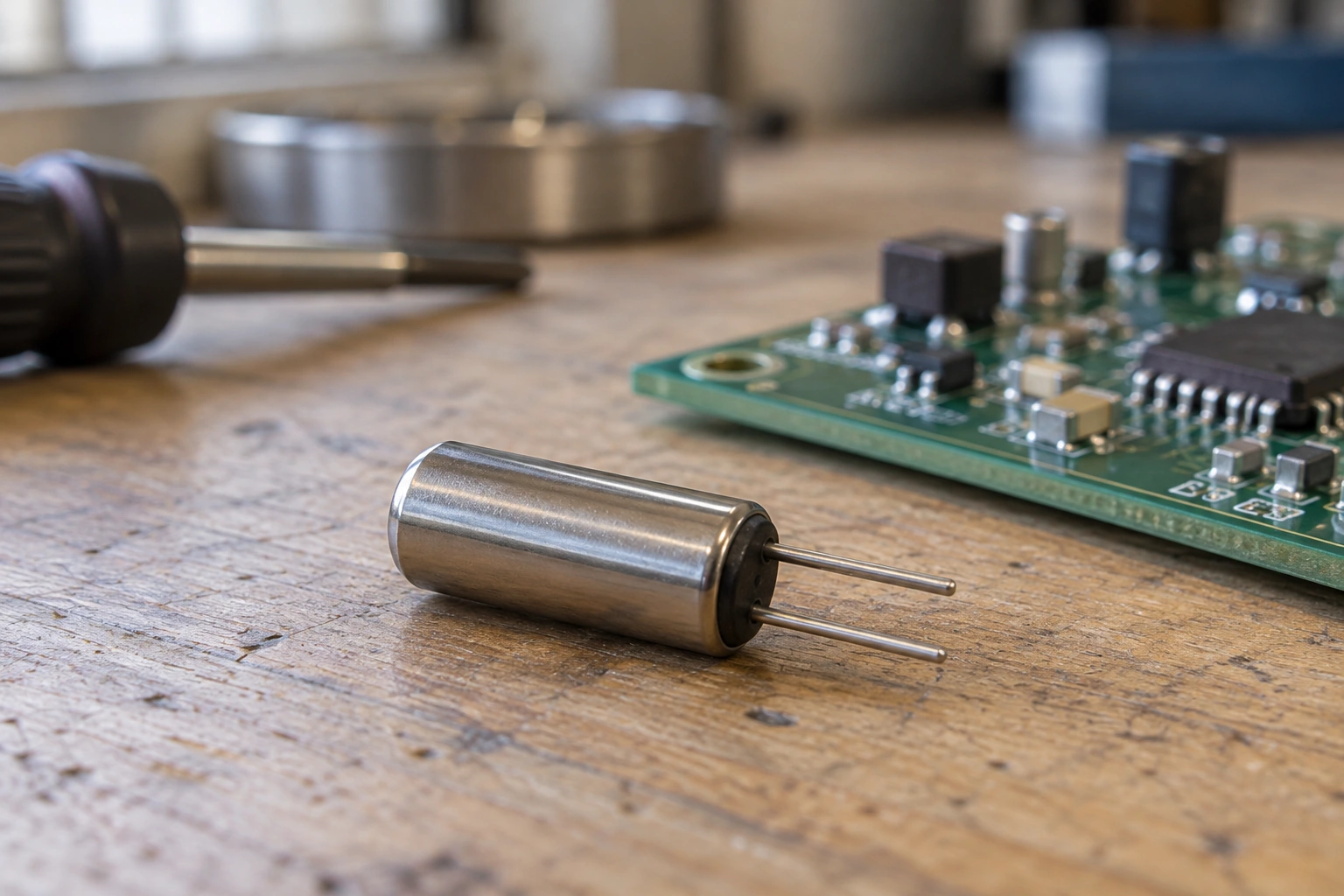
A tilt switch changes its electrical state when it reaches a specified orientation. In mechanical designs, gravity moves a ball or conductive liquid to make or break contact. Electronic designs sense inclination and change their output when the angle reaches a set threshold.
Tilt switches can detect tipping, trigger alarms, or provide simple control inputs. The sensing method and mounting direction affect what they detect. The output determines whether the controller receives a simple state change or, with a measuring sensor, a continuous angle reading.
How Does a Tilt Switch Work?
A tilt switch responds to a change in orientation relative to gravity. Once it reaches its switching condition, it opens or closes a contact or changes an electronic output.
Gravity-Based Detection
Inside a ball-type switch, gravity moves a conductive ball through a chamber. The circuit closes when the ball bridges two contacts and opens when it rolls away. A mercury switch works in a similar way, using conductive liquid to make or break the connection.
Electronic designs often use microelectromechanical systems (MEMS), tiny sensing structures built into a chip. An accelerometer senses gravity along its measurement axes. The electronics use those signals to determine inclination and control the output. A passive mechanical contact supplies no voltage of its own. This dry contact opens or closes a circuit that gets its power from another source.

Switching Angle and Orientation
The switching angle is the angle at which the output changes state. The manufacturer defines the reference position from which that angle is measured.
How you mount the switch affects the equipment angle at which it operates. Rotating the switch during installation changes its position relative to the equipment. Some devices detect tilt along one axis; others monitor two axes or respond to tilt in multiple directions. Use the mounting drawing to find the sensing direction and reference position. The open and closed states vary by design, so an upright switch is not necessarily open.
Output Stability
A stable output avoids repeated, unwanted state changes near the switching point. Different methods address the causes:
- Debouncing rejects brief contact changes while a mechanical ball settles.
- Hysteresis separates the trip and reset angles to reduce repeated switching near the threshold.
- A delay holds the output until the switching condition has lasted for a specified time.
Each method addresses a different problem. A delay can filter out a brief disturbance, but it also slows the response to an actual tilt event. Some electronic models have adjustable hysteresis and delay; these features are not available on every tilt switch.
Main Types of Tilt Switches
Common designs use a rolling ball, mercury, or electronic sensing. Start by choosing a sensing method, then compare electrical ratings and enclosure features.
| Type | How It Works | Main Selection Consideration |
| Ball tilt switch | A conductive ball moves to connect or separate contacts. | Mounting direction, contact behavior, and susceptibility to bouncing. |
| Mercury tilt switch | Mercury moves within a sealed chamber to connect or separate electrodes. | Restrictions on mercury-added products and suitability for the intended market. |
| Electronic tilt switch | A sensing element detects inclination; electronics compare it with a switching threshold. | Supply voltage, sensing axes, threshold accuracy, filtering, and output compatibility. |
Normally open and normally closed describe how the contacts behave. Single-axis and dual-axis describe the directions a device detects. These are separate specifications from the sensing method.
Where Are Tilt Switches Used?
Tilt switches are used when a change in orientation needs to trigger an alarm or equipment response. The detected position must correspond to the action the controller needs to take.
Equipment Tip-Over Detection
A tilt switch can signal when equipment tips beyond its permitted operating position. The controller can then stop a function or activate a warning.
The switch usually sends the detection signal to a separate device that controls the load. If this is a safety function, the sensor and control circuit must meet the machine’s required safety performance. A general-purpose switch alone does not establish that performance.
Platform Tilt Alarms
On work platforms and mobile equipment, an electronic tilt switch can signal when the angle exceeds a set limit. The controller may sound an alarm or restrict a particular movement. This threshold signal may not provide the continuous angle data needed for automatic leveling. Set the permitted angle according to the equipment design; a convenient sensor setting is not a basis for choosing the limit.

Tilt-Triggered Tamper Alarms
An enclosure, panel, or other object can use a tilt switch to detect tipping from its normal position. The switch’s change of state provides the alarm input. Mount the switch so the movement you want to detect takes it past its switching point. Tampering that causes too little tilt may go undetected, so the device cannot cover every type of intrusion.
Toys and Simple Electronic Controls
Ball-type switches can trigger lights, sounds, or other simple toy functions when an object tips. These controls need only a change of state, so they can work without a continuous angle reading. They work well for basic states such as “upright” and “tipped.” Detecting several precisely defined positions generally calls for more detailed sensing.
How Tilt Switches Differ From Tilt Sensors
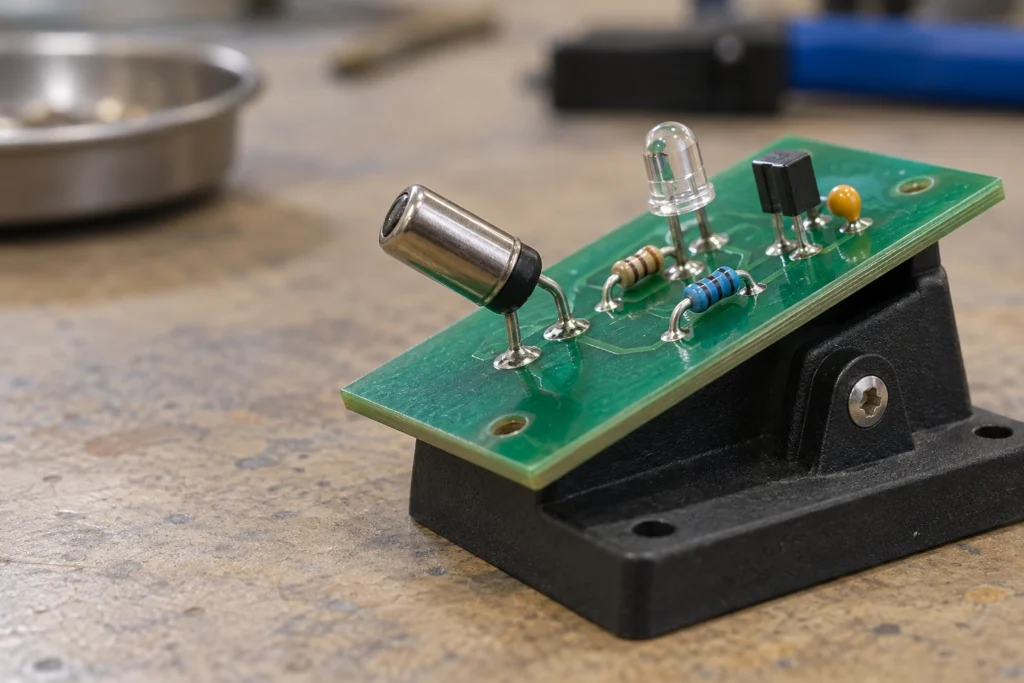
A tilt switch tells the controller whether a switching condition has been reached. A measuring tilt sensor reports the angle of inclination. The names overlap: “tilt sensor” can also mean a simple ball switch. An inclinometer usually measures angle relative to gravity, and some electronic devices provide both angle data and switching outputs.
A switching output is enough when the controller only needs to know whether a limit has been reached. If it needs the current angle for a display, positioning, or leveling, choose an inclinometer. An over-tilt alarm, for example, needs a threshold signal; a system that levels a platform needs angle feedback. The documented outputs tell you which function a device supports.
What to Check When Choosing a Tilt Switch
A mercury-free ball switch is a practical starting point for simple orientation detection in a device that stays relatively still. A mechanical switch can also suit a fixed switching angle, provided its documented tolerance and sensing direction meet your needs. Choose an electronic model if you need an adjustable threshold, configurable outputs, or accuracy that the available mechanical switches cannot achieve.
Check the following before choosing a model:
- Check the trip angle and its tolerance. Account for switching accuracy, temperature effects, and installation error when deciding whether the switch will operate within the allowed limit.
- Match the sensing direction to the equipment’s possible movement. Check whether the switch needs a particular mounting plane or a zero-setting procedure during installation.
- Identify whether the device has passive contacts, relay contacts, or a transistor output. For industrial inputs, PNP and NPN compatibility determines the current path and common-terminal connection.
- Match the contact or output rating to the actual voltage and current. A voltage rating alone does not show whether a signal-rated contact can directly switch a motor.
- Choose temperature and enclosure ratings that suit the installation, then verify the response time during the equipment’s normal movement.
To ask XURUI about a tilt-switch requirement, share your operating conditions. Include the required trip angle, mounting position, controller input, and vibration conditions so the team can assess availability and compatibility.
Frequently Asked Questions
Do I Need an External Pull-Up Resistor When Connecting to an MCU?
Not if the MCU has a suitable internal pull-up and the passive switch connects to ground. Use an external resistor if the internal pull-up cannot hold the open input reliably high. Check output-voltage compatibility separately for powered sensor modules.
Are Mercury Tilt Switches Banned Under Modern Environmental Regulations?
The EU generally prohibits manufacturing, importing, and exporting ordinary mercury tilt switches. Limited exceptions exist under Regulation (EU) 2017/852. Choose mercury-free devices for new EU designs; replacement exceptions require documented eligibility. Rules outside the EU vary.
Can a Tilt Switch Operate Reliably in High-Vibration Environments?
Yes, but basic rolling-ball switches are often unsuitable for sustained high vibration. Choose a model with documented vibration performance and test it on the running machine. Filtering adds delay, while acceleration-induced errors may require a gyro-stabilized sensor.
External Sources
- Adafruit — Tilt Sensor Guide
- DIS Sensors — How Does a Tilt Switch Work?
- TE Connectivity — Using Sensor Fusion to Improve the Performance of Tilt Sensors
- Aeron Systems — Tilt Sensor and Tilt Switch
- Arduino — INPUT, INPUT_PULLUP, and OUTPUT
- EUR-Lex — Regulation (EU) 2017/852 on Mercury