
This guide offers a deep dive into the principles and wiring techniques of the Single Pole Double Throw (SPDT) switch. We break down everything from terminal definitions (COM, NO, NC) to the practical advantages of using a Toggle Switch in industrial and DIY projects. Whether you are a hobbyist or a professional engineer, this comprehensive analysis of configurations and troubleshooting will help you achieve precision in your next electrical design.
1. Deconstructing the SPDT Logic: How It Works
To answer the question “What is an SPDT switch?”, we must look past the external metal lever and into the internal contact mechanism. Unlike a standard “On/Off” (SPST) switch that simply breaks a single line, the SPDT acts as a directional gate or a “selector.”
The Anatomy of the Three Terminals
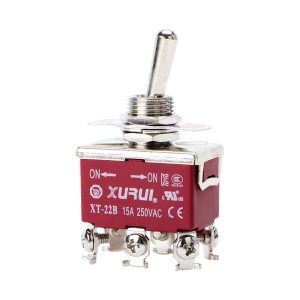
When you examine the base of a Toggle Switch designed for SPDT operation, you will typically find three distinct terminals or lugs. Understanding their specific roles is the first step toward successful installation:
- Common (COM): This is the “Pivot” or “Input” of the circuit. This is where your incoming power source or signal enters the switch. No matter which position the switch is in, the Common terminal is always part of the active path.
- Normally Closed (NC): In the switch’s default or “rest” position, the internal contact is physically touching this terminal. Electricity flows through this path automatically without any user intervention.
- Normally Open (NO): This path is “broken” or open by default. It only receives power from the Common terminal when a user actively moves the Toggle Switch lever to the opposite position, completing the second circuit.
The Mechanical Advantage of the Toggle Design
Inside the housing, a spring-loaded metal “pole” swings between two “throws” (outputs). This mechanical simplicity is what makes the Toggle Switch so superior to digital or push-button alternatives in critical environments. A mechanical toggle provides a definitive, tactile “click” and a visible lever position, giving the operator instant physical confirmation that the circuit has successfully moved from Path A to Path B.
Related Reading: Differences Between a Rocker Switch and a Toggle Switch
- Advanced Configurations and Switching Functions
Not all SPDT functions are identical. Depending on the complexity of your machinery or electronic device, you may require a specific type of movement or a neutral safety state.
ON-ON vs. ON-OFF-ON (The Center-Off Position)
The standard SPDT is an ON-ON configuration, meaning power is constantly flowing to one of the two outputs. However, many industrial and automotive scenarios require a “Neutral” state where nothing is powered.
- The Center-Off Advantage: An ON-OFF-ON Toggle Switch features a middle position where the Common pin is disconnected from both the NC and NO terminals. This is crucial for motor control (Forward – Stop – Reverse) or audio systems where you need to silence the output before switching between two different signal sources. It adds an essential layer of safety by allowing the operator to de-energize the system without fully committing to the other circuit path.
The Role of Auto Reset and Momentary Action
In safety-critical environments, you often want a circuit to stay active only while an operator is physically engaged with the control. This is known as Auto Reset or Momentary action.
A momentary Toggle Switch is designed with an internal spring mechanism that forces the lever back to its original position (either the “Off” center or the “NC” side) as soon as the user lets go. This is a standard requirement for winch controls, emergency signals, horn buttons, or “inching” machinery where precise, short bursts of power are necessary for fine adjustments.
3. Scaling Your Design: Multi-Pole Toggle Switches
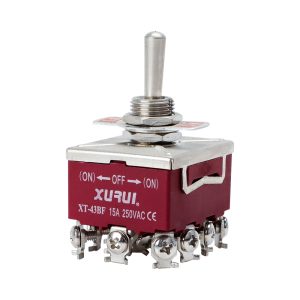
While the SPDT (Single Pole) switch is the most common, real-world engineering often demands the simultaneous control of multiple independent circuits. High-quality Toggle Switch lines are designed to scale in complexity while maintaining a uniform look and feel on the control panel.
Understanding Poles and Throws in Industrial Use
If your project requires more than one “Pole,” you can opt for multi-pole versions that house several independent SPDT mechanisms inside a single body, all actuated by the same lever:
- Double-Pole Double-Throw (DPDT): Effectively two SPDT switches side-by-side. This is used when you need to switch two different voltages at once, or switch both the “Live” and “Neutral” wires for a safer isolation.
- Triple-Pole (TPDT) and Four-Pole (FPDT): These are the heavy-duty workhorses of the industrial world. They allow an operator to switch three-phase power or manage four separate data signals with one physical movement of the Toggle Switch.
Comparison Table: Switching Configurations
4. Industry Applications: Where Reliability Matters
The Toggle Switch is favored across various sectors not just for its logic, but for its resilience against environmental stressors like vibration, dust, and moisture.
HVAC and Environmental Systems
In heating and cooling systems, the SPDT logic allows a system to toggle priority between a furnace and an air conditioner or between two different fan speeds. Because these switches are often located in dark or cramped utility rooms, the tactile feedback of a toggle lever allows a technician to identify the switch’s status purely by touch.
Marine and Automotive Engineering
Boats, trucks, and off-road vehicles rely on the Toggle Switch because of its mechanical locking nature. Unlike a touch screen or a soft-touch button, a toggle lever will not change position due to engine vibration or rough seas. SPDT switches are commonly used here for:
- Switching between Main and Auxiliary batteries.
- Toggling navigation lights between “Running” and “Anchor” modes.
- Operating hydraulic lifts or leveling jacks.
5. Professional Installation and Troubleshooting Tips
To ensure that your Toggle Switch lasts for the full duration of its intended mechanical life (often rated for 50,000 to 100,000 cycles), follow these professional installation standards.
Wiring and Heat Management
One of the most common causes of switch failure is poor soldering technique. When attaching wires to the lugs of a Toggle Switch:
- Use a Heat Sink: If possible, clip a small metal tool to the lug to dissipate heat.
- Work Quickly: Applying a soldering iron for more than 3-4 seconds can melt the internal plastic header, causing the internal poles to become misaligned.
- Mechanical Connection First: Thread the wire through the lug hole and crimp it before applying solder. This ensures a strong connection that doesn’t rely solely on the solder for structural integrity.
Verifying with a Multimeter
Never apply live power to a newly wired circuit without testing it first. Set your multimeter to the Continuity setting (the one that beeps):
- Touch the probes to COM and NC. The meter should beep.
- Flip the lever. The beeping should stop.
- Touch the probes to COM and NO. The meter should now beep. If the switch does not behave this way, you have likely misidentified the terminals or have a faulty component.
Safety Ratings: AC vs. DC
Always check the rating stamped on the side of your Toggle Switch. A switch rated for 15A at 125VAC may not be able to handle the same current at 24VDC. Because DC current creates more sustained “arcing” (sparks) when the contacts open, the switch must be specifically rated for the voltage type you are using to prevent the contacts from welding together.
Frequently Asked Questions
- Can I use an SPDT Toggle Switch as a simple On/Off switch?
Yes, this is very common. Simply connect your power to the COM terminal and your device to the NO terminal. Leave the NC terminal empty. The switch will now act as a standard On/Off (SPST) switch.
- What is the difference between a “Latching” and “Momentary” Toggle Switch?
A latching switch stays in the position you move it to. A momentary switch (or “Auto Reset”) has an internal spring that returns the lever to its home position as soon as you release it.
- Why does my SPDT switch have 6 pins instead of 3?
If your switch has 6 pins but is operated by a single lever, you actually have a DPDT switch. This allows you to control two separate SPDT circuits at the exact same time.
- What is a “3-Way” switch in home wiring?
In residential electrical terms, a “3-way switch” is simply an SPDT switch. It is called “3-way” because three wires are connected to it to allow a single light to be controlled from two different wall locations.
- Is a Toggle Switch better than a Rocker Switch?
It depends on the application. Toggle Switches are generally more durable and provide better tactile feedback for operators wearing gloves, while Rocker switches are often chosen for their aesthetic “flush” look on consumer appliances.
XURUI Engineering Team