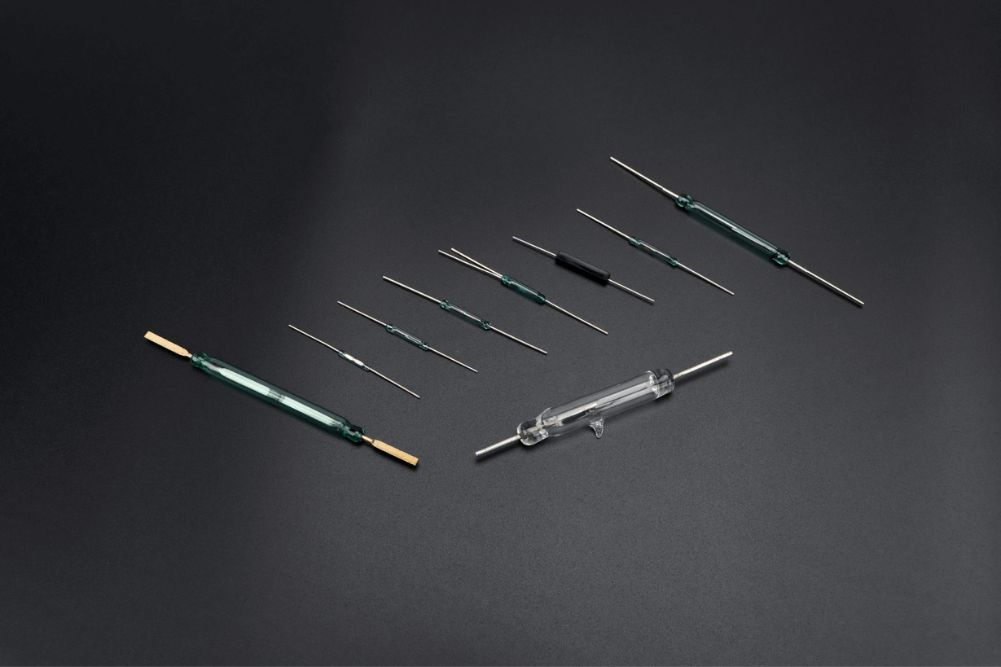
Reed switches are widely used in devices from home alarms to industrial machinery thanks to their compact size and reliability. A common question is: how long do they last? The answer depends on load type, environment, and installation. This article explains the key factors that affect lifespan, common problems, and ways to extend service life.
Factors That Affect Reed Switch Lifespan
Electrical Load
The type of load being switched is the single most significant factor.
- Light signal loads: Switching tiny voltages and currents, such as in alarm sensors, can give a reed switch a lifespan of hundreds of millions to billions of cycles.
- Resistive loads: When handling small but steady currents within rating, reed switches often reach tens of millions of operations.
- Inductive or capacitive loads: Devices like motors or relay coils generate voltage spikes that stress the contacts. Here, lifespan may drop to only one or two million cycles.
Practical tip: Always measure your load’s steady-state and inrush currents. A circuit that seems safe on paper may actually exceed ratings during startup.
Environmental Conditions
Even though reed switches are sealed in glass, they aren’t immune to environmental stress.
- Temperature extremes: High heat can shift magnetic sensitivity and accelerate wear. Extreme cold can make the glass more brittle.
- Moisture and condensation: A cracked seal allows humidity inside, which corrodes contacts.
- Shock and vibration: Repeated mechanical stress can crack the enclosure or trigger false signals.
Example: In automotive systems, reed switches in door or trunk sensors face constant vibration. Unless encapsulated, their lifespan can be significantly shorter than the same part in a stable indoor environment.
Related Reading: What is a reed switch and how does it work?
Handling and Installation
Due to improper handling, many reed switches fail before they’ve even been used.
- Lead bending too close to the glass body can cause stress cracks.
- Overheating during soldering damages the glass-to-metal seal.
- Magnetic interference from nearby transformers or motors may cause erratic operation.
Correct installation steps:
- Always clamp leads at least 3 mm from the glass body before bending.
- Use a temperature-controlled soldering iron and limit heating to just a few seconds.
- Mount away from strong magnetic fields or shield the switch if impossible.
Common Problems Users Face
Contact Welding
When a reed switch closes on an inductive load, the energy spike can weld the contacts shut, permanently closing the switch.
Solution: Use a flyback diode across DC coils or an RC snubber/TVS diode for AC circuits.
Seal Damage
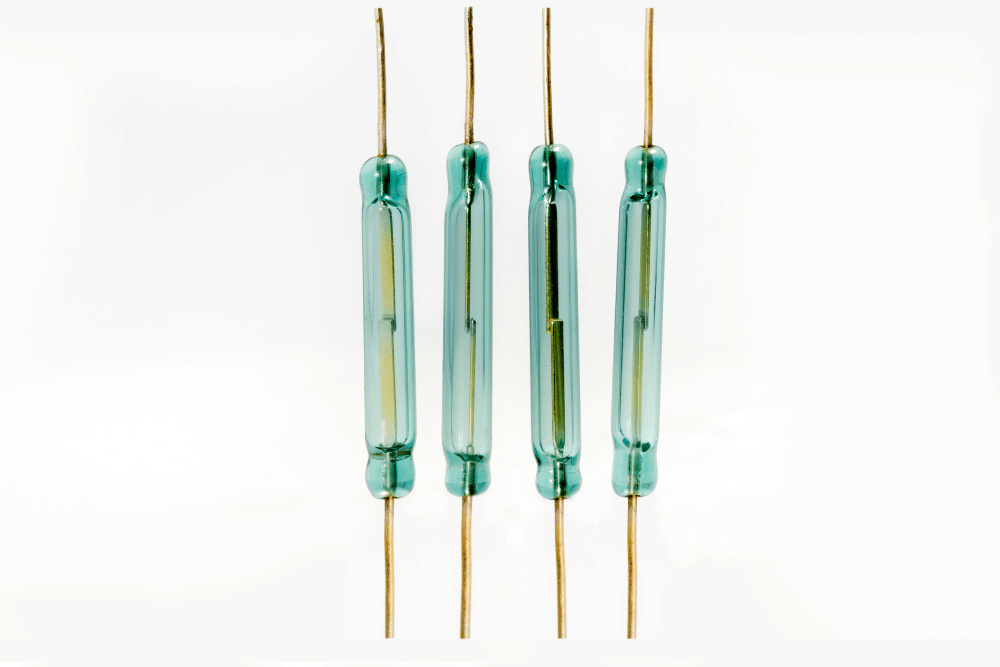
If the glass capsule breaks or the seal is weakened, moisture enters, leading to corrosion.
Solution: Choose resin-encapsulated or epoxy-sealed models in environments where vibration or humidity is present.
High Contact Resistance
Over time, surfaces may oxidize or degrade, raising resistance and producing weak or unstable signals.
Solution: Replacement is the only option, but early detection helps avoid downtime.
False Triggering
External magnetic fields can cause unintended switching.
Solution: Keep reed switches away from strong magnetic sources or add magnetic shielding.
How to Extend the Life of a Reed Switch
Match the Load Correctly
Never exceed the rated voltage and current.
Steps to apply:
- Measure current draw both at startup and during steady operation.
- Compare values with reed switch ratings.
- If close to the limit, add protective circuits or select a higher-capacity switch.
Use Protective Circuits
Protection greatly extends switch life, especially for inductive loads.
- DC circuits: Add a reverse-biased diode across the coil.
- AC circuits: Install an RC snubber or TVS diode across the load.
Steps to apply:
- For a relay coil, solder a diode like 1N4007 across the terminals. This absorbs voltage spikes and reduces stress on contacts.
Choose the Right Reed Switch Type
Not all reed switches are the same.
- Standard reed switches: Best for low-power signals and general sensing.
- Mercury-wetted reed switches: Long life and clean switching at higher loads, but restricted due to mercury handling.
- Encapsulated reed switches: Withstand moisture, dust, and vibration.
Test in Real Conditions
Datasheet numbers are often idealized. Real-world testing is essential.
Steps to apply:
- Build a prototype using your actual load and environment.
- Cycle the switch repeatedly.
- Record performance until degradation appears.
- Use the data to refine design and maintenance schedules.
When to Consider Alternatives
Solid-state options may be better if your project demands ultra-long life or zero maintenance.
- Hall effect sensors: With no moving parts, they offer virtually unlimited lifespan. They do require continuous power.
- Optical sensors: Exact and reliable but more expensive and sensitive to dust or dirt.
Comparison: A reed switch may last decades in a home alarm sensor, but in a factory line running 24/7 with thousands of activations per day, a Hall sensor is often the better choice.
Frequently Asked Questions (FAQ)
How many years will a reed switch last?
Reed switches often last 10–20 years in light-duty applications like home door sensors. Under heavy switching loads, their lifespan may shrink to a few years.
Why did my reed switch fail early?
Early failures happen when inductive loads are switched without protection, causing welded contacts. Poor handling during installation is another common cause.
Can a reed switch be repaired?
No. Once the contacts weld or the seal is broken, the only solution is replacement.
How can I tell if a reed switch is near end-of-life?
Look for intermittent signals, rising resistance, or inconsistent switching. These are warning signs.
Are reed switches suitable for safety-critical systems?
They can be, but only with proper protective circuits and redundancy. In medical or aerospace systems, solid-state sensors are often preferred for higher reliability.
Do reed switches consume power?
No. Unlike Hall sensors or optical sensors, reed switches are passive components. They only conduct when actuated, which makes them ideal for battery-powered devices.
Final Thoughts
Depending on how it is used, a reed switch’s lifespan can range from just over a million cycles to several billion. Careful design, correct installation, and protective circuits are key to maximizing performance. For applications where absolute reliability is required, solid-state options may be a better fit, but for most uses, reed switches remain a dependable and cost-effective choice.