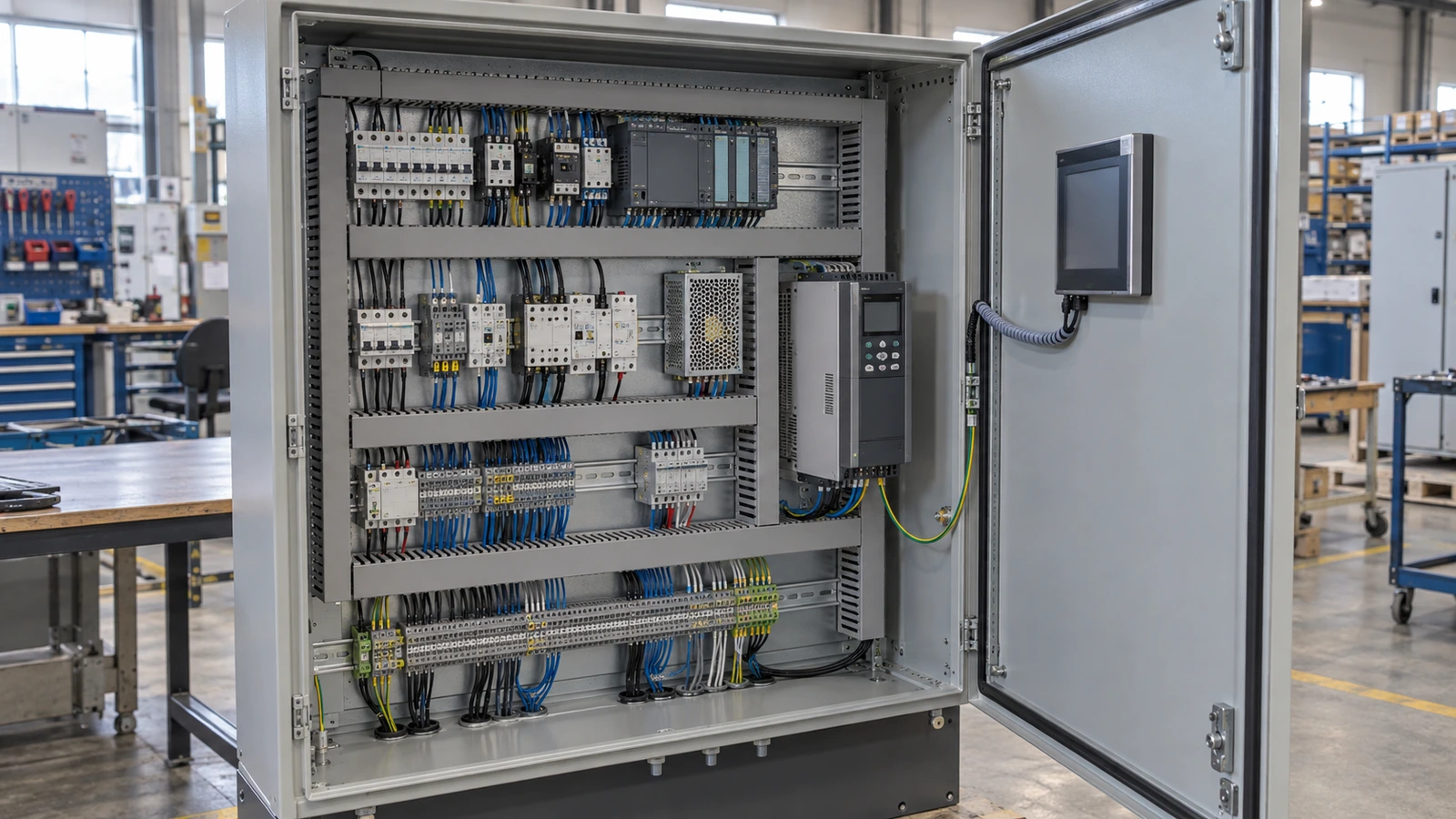
Industrial control panel design arranges power, protection, control, and operator devices so equipment can run safely and be maintained. Start with the supply and load requirements, then account for available fault current, heat, wiring, and enclosure conditions.
This guide covers panels used with industrial machinery and automation equipment. A panel, the machine it controls, and the electrical installation fall under different requirements. Define those boundaries early to avoid gaps in design and testing.
Which Standards and Regulations Govern Industrial Control Panels?
The governing standards depend on where the equipment will be installed and whether the scope covers the panel alone or the entire machine.
North American Standards
In the United States, UL 508A covers industrial control panel construction and markings. NFPA 79 covers the electrical equipment of industrial machinery, while the National Electrical Code (NEC) governs electrical installations. A panel built to UL 508A does not, by itself, show that the connected machine meets its safety requirements.
Before selecting protective devices for a U.S. installation, identify the supply characteristics and available fault current. NEC Article 409 requires industrial control panels to display a short-circuit current rating (SCCR). UL 508A Supplement SB provides an accepted method for determining the panel rating.
International Standards
IEC 60204-1 covers the electrical equipment of machines, starting at the machine’s supply connection. IEC 61439 covers low-voltage switchgear and controlgear assemblies, including their construction and verification. The standards have different scopes: IEC 60204-1 may apply to a machine while the relevant part of IEC 61439 applies to an assembly within it.
Environmental Protection
NEMA enclosure Types and IP ratings cover overlapping but different environmental protections. An IP code rates protection against access, solid objects, and water. NEMA Types also address conditions such as corrosion, icing, oil, and coolant. An IP rating is not a direct equivalent of a NEMA Type.
Choose an enclosure for the actual exposure, then consider the installed assembly, including door devices, cable entries, and seals. Adding openings can affect the protection provided by an otherwise suitable enclosure.
What Are the Core Components of an Industrial Control Panel?
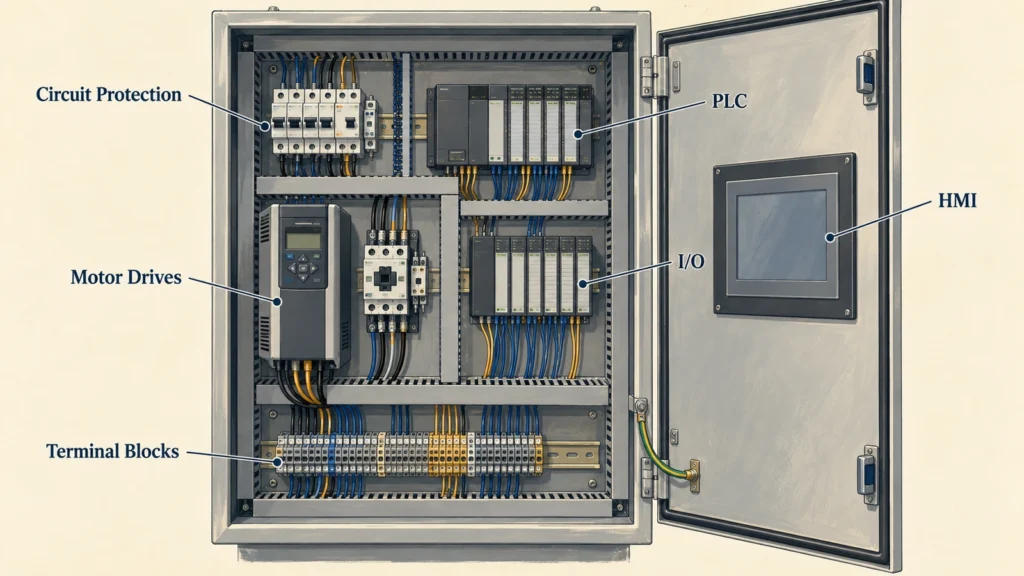
A panel needs a protected power path, control logic, connections to field devices, and an interface for operators.
Power Distribution and Circuit Protection
Disconnects, distribution blocks, transformers or power supplies, breakers, and fuses deliver power and protect circuits from specified faults or overloads. Size conductors and protective devices for the circuits they serve. A device’s interrupting rating is different from the SCCR of the assembled panel.
Control and Logic Hardware
Relays, timers, and programmable logic controllers (PLCs) turn input conditions into control commands. A relay can handle a simple interlock; a PLC suits sequences with many inputs, outputs, or operating states. Document which loads each output may energize and how the system should respond to power loss or a fault.
Motor Drives and Actuation Equipment
Contactors switch motor power. Variable-frequency drives control motor speed by changing output frequency and voltage. Choose the starting and control method to suit the motor, load, duty cycle, and required motion. Set up the drive and protective devices according to its instructions and the motor circuit.
I/O Modules and Field Connectivity
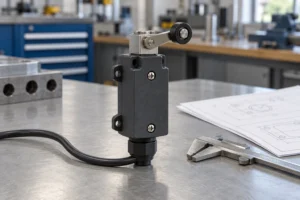
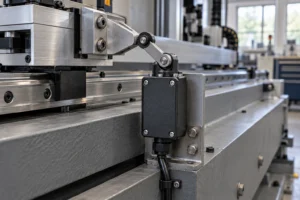
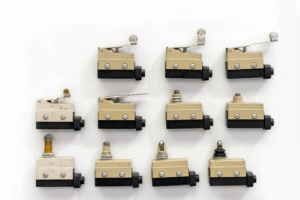
Input/output (I/O) modules and terminal blocks connect the panel to external sensors and actuators. For each field device, record its supply, signal type, terminal, and expected state so the wiring matches the PLC configuration. For a position switch, check actuator travel and mounting geometry as well as the contact arrangement.
Operator Interface and HMI Devices
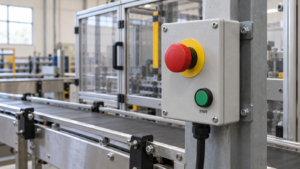
Operator controls should make machine states clear and help prevent unintended commands. A human-machine interface (HMI) displays information and accepts programmed inputs. Physical switches provide direct actions. For a panel-mounted toggle switch, match the pole and throw arrangement, electrical load, mounting cutout, and sealing option to the circuit.
What Engineering Best Practices Ensure Control Panel Reliability?
Manage heat, electrical interference, fault current, and machine hazards before components crowd the enclosure.
Thermal Management and Enclosure Cooling
Calculate the heat produced by installed devices at the expected load and ambient temperature. Compare it with the enclosure’s ability to release heat. Add ventilation or cooling if the internal temperature could exceed a component’s rating, and preserve each device’s specified mounting clearance.
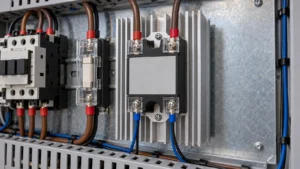
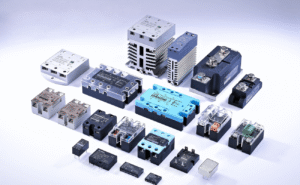
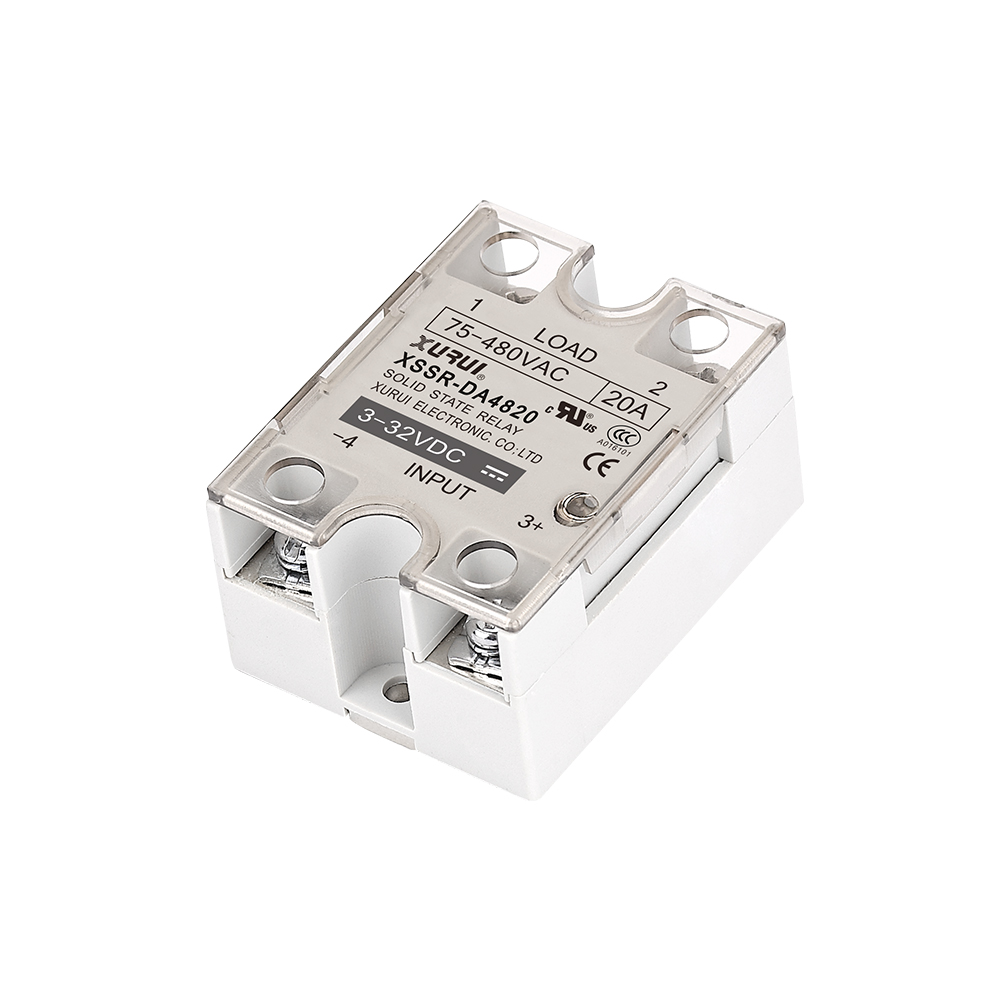
A solid-state relay needs a thermal path from its semiconductor to a suitable heatsink and the surrounding air. Its current rating alone does not show whether it will stay within temperature limits. Check the load, duty cycle, ambient temperature, and mounting arrangement.
EMC and Electrical Noise Mitigation
Electromagnetic compatibility (EMC) improves when noisy power circuits are less likely to couple into sensitive signals. Route drive output cables away from low-level sensor and communication wiring, limit long parallel runs, and bond protective earth and cable shields as the device instructions specify. If a signal remains unstable, inspect its routing and terminations before changing the control logic.
SCCR and Machine Safety Systems
The panel’s SCCR must meet or exceed the available fault current at its supply terminals. Determine that fault current at the intended connection point, then establish the assembly rating from the components and protective-device combinations. A breaker’s interrupting rating alone does not establish the panel SCCR.
For machine safety, identify the hazardous motion and required stopping behavior before selecting safety interlocks or safety controllers. Validate the complete function, including the guard device, wiring, logic, and final stopping element. An interlock alone does not make a machine safe.
How Do You Optimize Panel Layout, Wiring, and Ergonomics?
Give devices enough room for heat release, wiring, inspection, and replacement, while keeping operator controls easy to use.
Spatial Planning and DIN Rail Placement
Arrange incoming power and protective devices so their connections are accessible, then group control equipment by function. Follow the specified clearances around drives and power supplies. Leave room for wire duct and service access, and make sure cables do not press against the door when it closes. Keep frequently used controls and their labels visible.
Cable Management and Wire Labeling
Route power, drive output, control, and communication wiring according to their electrical requirements. Avoid overfilling wire duct; support cables near terminals and protect them at sharp edges and enclosure entries. Label both ends of each conductor with identifiers from the drawings so technicians can trace circuits without relying on wire color.

What Testing Procedures Guarantee Control Panel Quality Before Delivery?
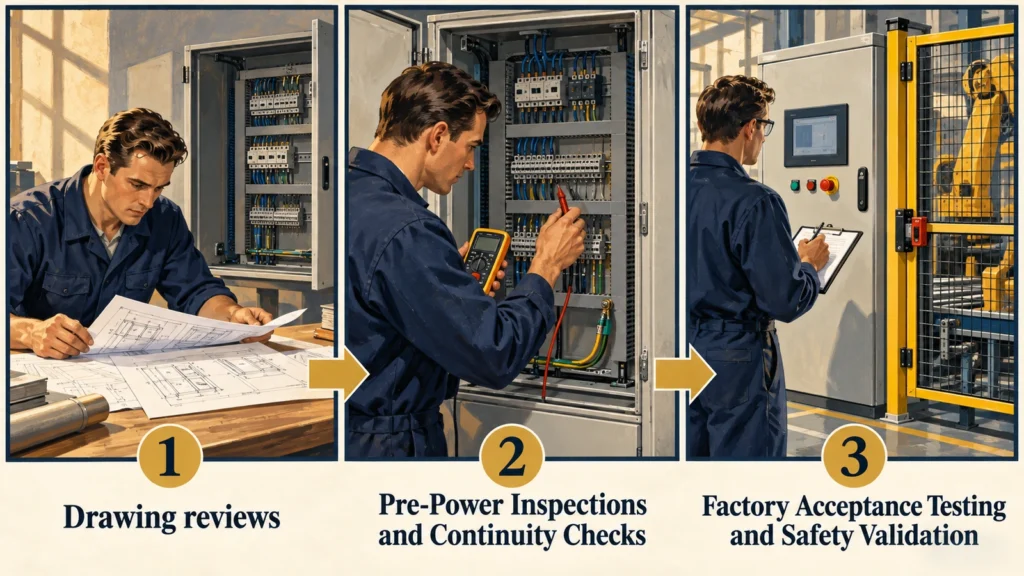
No single test guarantees future quality. Drawing reviews, unpowered inspections, electrical checks, and functional tests can show whether the delivered panel matches its design and operates as specified.
Electrical Schematics and Engineering Documentation
The panel wiring diagram, schematic, and layout provide the reference for testing the finished panel. The drawing package should identify supply sources, protection, device tags, wire and terminal numbers, field connections, and the current revision. Compare the panel with that revision before testing. Records tied to an obsolete drawing are difficult to use or reproduce.
Pre-Power Inspections and Continuity Checks
Before energizing the panel, check component models and ratings, terminal tightness, conductor routing, protective bonding, and enclosure entries against the drawings and device instructions. Continuity checks can find open conductors and incorrect connections, but they do not prove that a circuit will operate correctly under load. Use insulation or dielectric tests that suit the connected electronics, and disconnect vulnerable devices when the test procedure requires it.
Factory Acceptance Testing and Safety Validation
During factory acceptance testing (FAT), run documented input, output, alarm, and operating sequences against stated acceptance criteria. Simulate relevant faults and power loss, then record the results and any corrections. If the panel is part of a machine safety function, test that function on the assembled machine. A panel-only test cannot establish the machine’s final stopping behavior.
If FAT identifies a switch or interlock mismatch, submit the component specifications to XURUI, including circuit voltage and load, actuator motion, environment, and target market, to assess a replacement.
FAQs
What Key Factors Determine the Cost of a Custom Control Panel?
Cost is driven by the electrical rating, component count, enclosure, controls, documentation, and testing scope. Define the required SCCR and environmental protection before comparing quotes.
Should You Build Control Panels In-House or Outsource to a Certified Panel Shop?
Build in-house if you can meet the design, testing, documentation, and certification requirements. Otherwise, use a panel shop certified for the specified panel type. Panel certification does not cover the connected machine.
When Should an Existing Control Panel Be Retrofitted Rather than Completely Replaced?
Retrofit when the enclosure, wiring space, and ratings can support the changes. Replace the panel if damage, insufficient space, or an inadequate SCCR makes the revised design impractical.
External Sources
- UL Solutions: Short-Circuit Current Ratings for Combination Motor Controller Components
- UL Solutions: Scope of Industrial Control Panel Certification
- IEC 60204-1:2016, Safety of Machinery—Electrical Equipment of Machines
- IEC 61439-1:2020, Low-Voltage Switchgear and Controlgear Assemblies
- NEMA: Enclosure Ratings FAQ
- Rockwell Automation: General Instructions for an EMC Compliant Installation