When buying a reed switch, you may see a number marked as AT, such as 10 AT, 20 AT, or 40 AT. This small specification can make a big difference in how the switch works with a magnet. If the AT value is wrong, the switch may trigger too early, too late, or not at all. This guide explains what AT means and how to choose the right reed switch for your application.
What Does AT Mean On A Reed Switch?
AT stands for Ampere Turns. In simple terms, it measures how much magnetic force is needed to operate a reed switch. A reed switch works when a magnetic field pulls two tiny metal reeds together inside a sealed glass tube. Once the reeds touch, the circuit closes.
The AT value tells you how sensitive the reed switch is to that magnetic field. A low AT value means the switch is highly sensitive. It can operate with a weaker magnet, a smaller magnet, or a magnet placed farther away. A high AT value means the switch is less sensitive. It usually needs a stronger magnet or a shorter distance between the magnet and the switch.
For buyers, AT is not just a technical number. It affects installation distance, magnet size, response accuracy, false triggering risk, and long term reliability.
How A Reed Switch Works With A Magnet
The Basic Working Principle
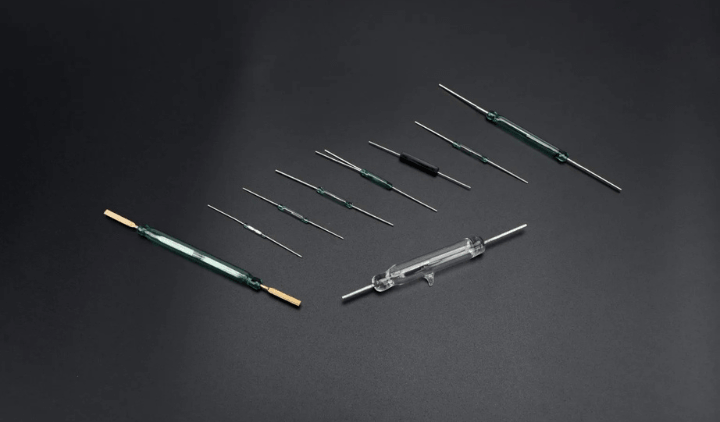
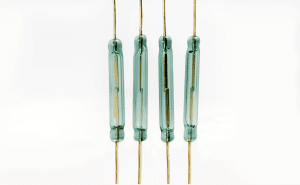
A reed switch is made of two thin metal blades sealed inside a glass capsule. These blades are usually separated by a tiny gap. When a magnet comes close enough, the magnetic field causes the blades to attract each other. The blades touch, and the electrical circuit turns on.
When the magnet moves away, the magnetic field becomes weaker. The blades separate again, and the circuit turns off.
This simple design makes a reed switch useful in door sensors, level sensors, flow meters, position detection, security systems, appliances, and industrial control equipment.
Why Sensitivity Matters
The sensitivity of a reed switch decides how easily it responds to a magnet. If the switch is too sensitive, it may activate when the magnet is not in the exact position you want. It may also react to nearby magnetic fields. If the switch is not sensitive enough, it may fail to activate unless the magnet is very close.
That is why the AT value is important. It helps you match the reed switch to the magnet, mounting distance, and application environment.
Low AT Vs High AT: What Is The Difference?
Low AT Reed Switches
A low AT reed switch is more sensitive. It requires less magnetic force to operate. This can be helpful when you have limited space, a small magnet, or a wider gap between the switch and the magnet.
Low AT switches are often used in compact devices, battery powered products, and applications where the magnet cannot be placed very close to the switch. For example, a small handheld device may need a sensitive reed switch because there is not enough room for a large magnet.
However, higher sensitivity also has a tradeoff. A very low AT reed switch may be more likely to respond to unwanted magnetic fields or nearby metal parts that change the magnetic field. In some applications, this can cause false triggering.
High AT Reed Switches
A high AT reed switch is less sensitive. It needs a stronger magnetic field to operate. This can be useful when you want the switch to activate only when the magnet is very close.
High AT switches are often chosen for applications where precise positioning matters. They can also help reduce accidental triggering in environments with vibration, nearby magnets, or magnetic interference.
The tradeoff is that you may need a larger magnet, a stronger magnet, or a tighter mounting gap. If the magnet is too weak or too far away, the reed switch may not close reliably.
What Is Operate AT Or Pull In AT?
Operate AT Meaning
Operate AT, also called pull in AT, is the magnetic force needed to close a normally open reed switch. In other words, it is the point where the reed switch changes from off to on.
For example, if a reed switch is rated at 15 to 20 AT, it means the switch is expected to operate within that sensitivity range when tested under standard conditions. The exact operation in your product may still depend on magnet type, magnet direction, distance, temperature, and nearby materials.
Why AT Is Usually A Range
Many reed switches list an AT range instead of one exact number. This is normal because reed switches are small mechanical magnetic components, and manufacturing tolerances can create slight differences between units.
A reed switch marked 10 to 15 AT may not behave exactly the same as another switch marked 20 to 25 AT. That is why engineers often test the selected reed switch with the actual magnet and housing before final production.
What Is Release AT Or Drop Out AT?
The Switch Does Not Open At The Same Point
A reed switch usually does not open at the exact same magnetic level where it closes. The magnet may need to move farther away before the contacts release. This difference is called hysteresis.
For example, a reed switch may close when the magnet comes within a certain distance, but it may not open until the magnet moves a little farther away. This is normal behavior.
Why Release AT Matters
Release AT matters when your application needs a clear on and off position. In door sensors, liquid level switches, and position sensors, you need to know when the switch turns on and when it turns off.
If the release point is too close to the operate point, the switch may chatter when the magnet is near the boundary. If the release point is too far away, the system may respond later than expected. Good design considers both the operate point and the release point.
How To Choose The Right AT Value
Start With The Magnet Distance
The first thing to consider is the distance between the magnet and the reed switch. A larger distance usually requires a more sensitive reed switch or a stronger magnet.
If your design has a wide gap, choose a lower AT value. If your design has a very tight gap and you only want the switch to trigger at close range, a higher AT value may be better.
Consider Magnet Size And Strength
The reed switch and magnet work as a pair. A strong magnet can activate a higher AT reed switch. A small or weak magnet may need a lower AT reed switch.
Do not choose the AT value without thinking about the magnet. Two products may use the same reed switch, but if the magnets are different, the operating distance can be very different.
Think About The Direction Of The Magnet
Magnet orientation also affects performance. A reed switch does not respond the same way from every direction. The strongest activation usually depends on how the magnet is positioned relative to the reed blades.
Before final installation, test the magnet from the actual direction it will move in the product. This is especially important for sliding, rotating, or hinged mechanisms.
Check The Application Environment
A low AT reed switch may work well in a clean and controlled environment. But in an industrial setting with vibration, magnetic fields, motors, or metal structures nearby, a higher AT reed switch may be safer.
The right choice depends on whether you need maximum sensitivity or more resistance to accidental activation.
Related Reading: How Long Does a Reed Switch Last?
Common Reed Switch Applications And AT Selection
Door And Window Sensors
Door and window sensors often need reliable activation with a small magnet. A lower to medium AT reed switch is commonly useful because the gap between the frame and moving part may vary.
However, if the sensor is installed near other magnetic materials, the design should be tested carefully to avoid false triggering.
Liquid Level Sensors
In a float level sensor, the magnet is usually inside a moving float. The reed switch must activate at a specific fluid level. AT selection affects how accurately the switch responds as the float rises or falls.
If the reed switch is too sensitive, the switching point may be less precise. If it is not sensitive enough, the float magnet may not activate the switch reliably.
Speed And Position Sensors
Reed switches can detect rotating magnets or moving parts. In these applications, response distance and timing are important. A low AT reed switch may help detect a magnet passing by quickly, but it may also increase the risk of unwanted signals.
For speed sensing, the magnet strength, switching speed, and contact rating should all be reviewed together.
Industrial Equipment
In industrial control systems, reed switches may be exposed to vibration, electrical noise, metal housings, and nearby motors. A medium or higher AT reed switch may help reduce false operation, but it must still be sensitive enough for the chosen magnet and mounting distance.
Do Not Choose A Reed Switch By AT Alone
Check Contact Rating
AT tells you about magnetic sensitivity. It does not tell you how much voltage or current the reed switch can safely switch. Always check the contact rating before buying.
If the load is too high, the contacts may arc, stick, or fail early. For higher power loads, the reed switch may need a protection circuit or may need to control a relay, transistor, or other switching device instead of driving the load directly.
Check Normally Open Or Normally Closed Type
Most reed switches are normally open, which means the circuit is open until a magnet activates the switch. Some are normally closed, meaning the circuit opens when the magnet is present.
Before buying, confirm the contact form. AT value is important, but the circuit logic must also match your design.
Check Size And Mounting Style
Reed switches come in different capsule sizes, lead styles, and packaged sensor housings. A smaller reed switch may fit better in compact products, but it may have a different sensitivity range and contact rating.
If you are replacing an old reed switch, do not match only the size. Match the AT range, contact rating, electrical type, and physical position.
Check Temperature And Environment
Temperature can affect magnets, materials, and switch behavior. Moisture, shock, vibration, and chemicals may also affect the complete sensor assembly.
The glass capsule of a reed switch is sealed, but the leads, housing, cable, and mounting area still need to be suitable for the environment.
Common Mistakes When Buying A Reed Switch
Choosing The Lowest AT Automatically
Some buyers assume the lowest AT reed switch is always the best. That is not true. A very sensitive reed switch may trigger too easily. It can cause false signals if the magnet path is not controlled.
The best AT value is the one that fits the magnet, distance, and trigger point.
Ignoring The Magnet
A reed switch does not work alone. If the magnet is too weak, even the correct reed switch may not operate well. If the magnet is too strong, the switch may activate too early or stay activated longer than expected.
Always test the reed switch and magnet together.
Forgetting About Mounting Materials
Steel, iron, and other magnetic materials can change the magnetic field around the reed switch. This can shift the operating distance and make the switch behave differently after installation.
If the switch works on your desk but fails inside the final product, nearby metal parts may be one reason.
Replacing A Reed Switch Without Matching AT
When replacing a reed switch, matching the voltage and current rating is not enough. If the AT value is different, the new switch may activate at a different distance.
For repair work, try to match the original AT range as closely as possible, or test the replacement carefully before final use.
Simple Buying Guide For Reed Switch AT
Choose Lower AT When
Choose a lower AT reed switch when the magnet is small, the distance is larger, the available space is limited, or the product needs high sensitivity. This is often useful in compact sensors and low power devices.
Choose Higher AT When
Choose a higher AT reed switch when the magnet is strong, the activation distance is short, or you want to reduce false triggering. This can be useful in industrial devices, mechanical position sensing, and applications with nearby magnetic interference.
Test Before Final Production
Even if the datasheet looks right, testing is still important. The final result depends on the reed switch, magnet, mounting distance, angle, enclosure, and surrounding materials. A simple bench test can prevent unstable switching later.
Final Thoughts
AT is one of the most important specifications when buying a reed switch. It tells you how sensitive the switch is to a magnetic field. A lower AT value means higher sensitivity, while a higher AT value needs a stronger or closer magnet. To choose correctly, match the AT value with your magnet, distance, mounting design, contact rating, and real operating environment.
XURUI Engineering Team