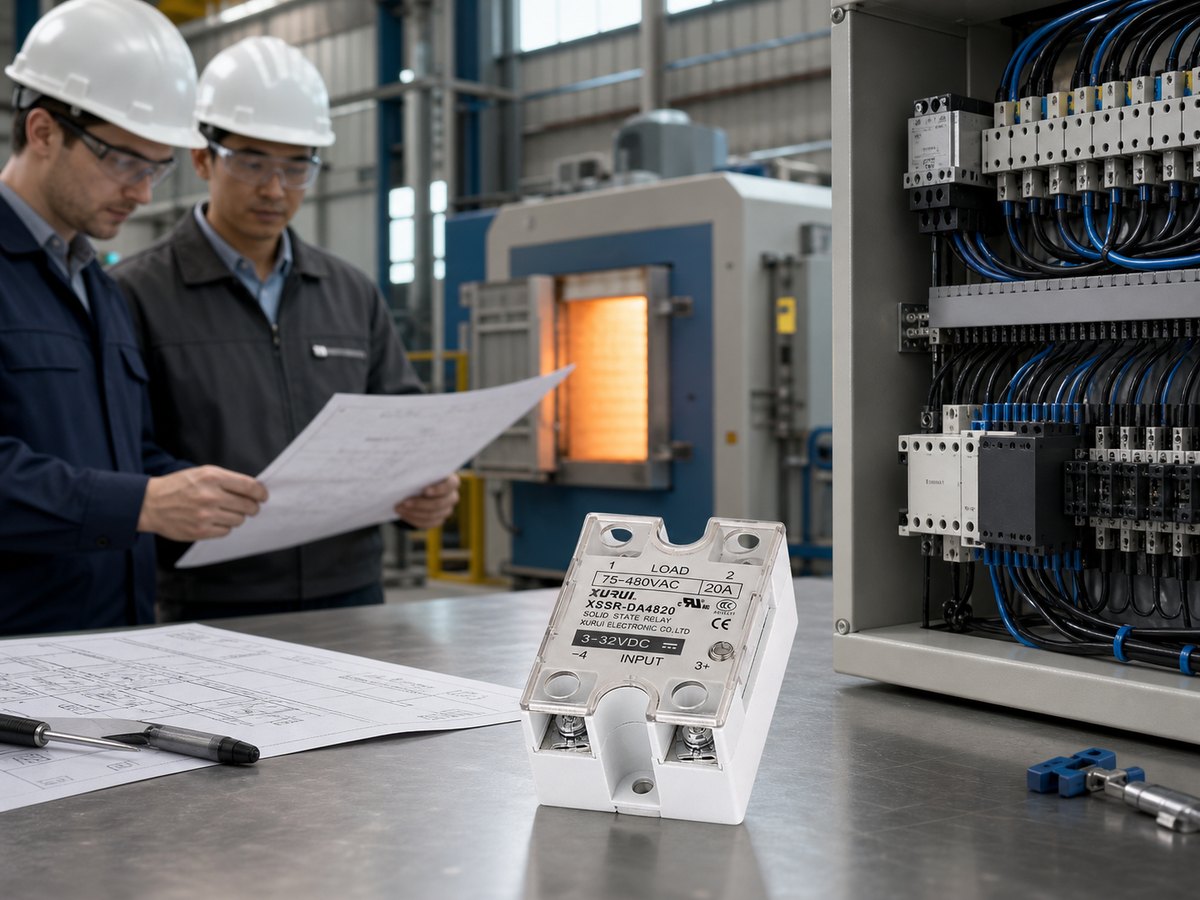
Furnace manufacturers should source solid state relays from a zone-level electrical and thermal specification. Current and voltage labels alone do not cover controller compatibility, cabinet heat, protection, certification, or production controls.
This guide turns that specification into SSR selection, supplier qualification, sample testing, and final order-code approval.
What SSR Requirements Should Furnace Manufacturers Define?
Build one specification line for every heating zone before comparing SSR catalogs. Each line should identify the heater circuit, controller, panel conditions, target market, and production volume.
Heater Load and Electrical Supply
Record the supply voltage, frequency, phase, heater connection, rated power, nominal current, minimum cold resistance, and duty cycle. For a single-phase resistive heater, estimate current with I = P / V. For a balanced three-phase load, use I = P / (sqrt(3) x VLL). Recalculate from the actual heater connection before selecting the SSR.
Cold resistance, transformer inrush, or mixed loads can raise startup current above the hot running value. Check those conditions against the SSR’s repetitive current, surge rating, load type, and output voltage range. An AC-output SSR cannot replace a DC-output device because AC models depend on load current reaching zero to turn off.
Control Signal and Switching Profile
Match the SSR input to the PLC or PID output. Record the signal range, available drive current, polarity, off-state leakage, and switching period. If one output drives more than one SSR, add their input current and confirm that the signal still falls below each SSR’s release threshold when off.
A voltage-pulse output can drive an on and off SSR through time-proportional control. A 4 to 20 mA or 0 to 10 V signal may require a compatible power regulator. List that regulator as a separate controlled component.
Panel Temperature, Mounting, and Heat Dissipation
Use the highest expected air temperature at the SSR location, not the room temperature outside the cabinet. Record mounting direction, spacing, airflow, altitude, nearby heat sources, and terminal clearance.
Select the heat sink from the exact series loss and derating curves. Then verify the interface material, mounting surface, fastener torque, and airflow. The SSR heat sink requirement depends on installed current and temperature, so a generic sizing rule is not enough.
Certification and Production Requirements
State the destination markets and required approvals in the RFQ. The certificate or listing must cover the exact order code, rating, and conditions of use. A mark on another family model does not confirm the proposed part.
Define the repeat-order controls that matter:
- Approved factory and manufacturing location
- Lot or date-code traceability
- Incoming inspection requirements
- Advance notice for component, process, factory, or certification changes
- Packaging, storage, delivery, and service-life requirements
For a US furnace, confirm whether NFPA 86 applies. Record the required edition, furnace class, local code, and certification path.
How Should Furnace Manufacturers Select the SSR Type and Rating?
Select the circuit architecture first. The case current rating does not show how much current the SSR can carry inside the finished cabinet.
Single-Phase and Three-Phase Circuits
Use a single-phase AC SSR for one compatible single-phase heater circuit. For a three-phase heater, use a rated three-phase SSR or a documented arrangement of single-phase devices. The schematic must show which phases switch, how the system detects phase loss, and how the safety circuit removes power.
Three single-phase SSRs can simplify channel-level service. An integrated three-phase unit can reduce wiring and panel space. Compare heat concentration, fuse arrangement, terminal access, control channels, and replacement needs. The differences in AC, DC, and three-phase SSR wiring also affect polarity and terminal use.
On and Off Control Versus Proportional Power Control
Use an on and off SSR when the controller varies average heater power through timed switching. This method suits resistance-heated zones whose thermal mass smooths each cycle.
Use a power regulator when the process needs control within each AC cycle. Phase-angle control changes the current waveform, which affects harmonics, electromagnetic compatibility, RMS current, and heat. XURUI XSSR products handle on and off switching, while the XSSVR-W1/W2 phase-angle AC voltage regulator is a separate product type.
Zero-Cross and Random Turn-On Switching
Choose zero-cross turn-on for compatible AC resistance heaters under normal on and off or time-proportional control. Starting near zero load voltage usually reduces switching noise.
Choose random turn-on when the control method requires firing at another point in the AC cycle. Phase-angle control needs controlled firing, but a random turn-on SSR alone does not form a complete proportional power system. Transformer primaries and high-inrush elements may require a different switching plan.
Current Rating, Thermal Derating, and Circuit Protection
Start with nominal heater current, then account for cold resistance, supply variation, cabinet temperature, mounting, and heat sink derating. Use the exact model curves instead of a fixed oversizing ratio.
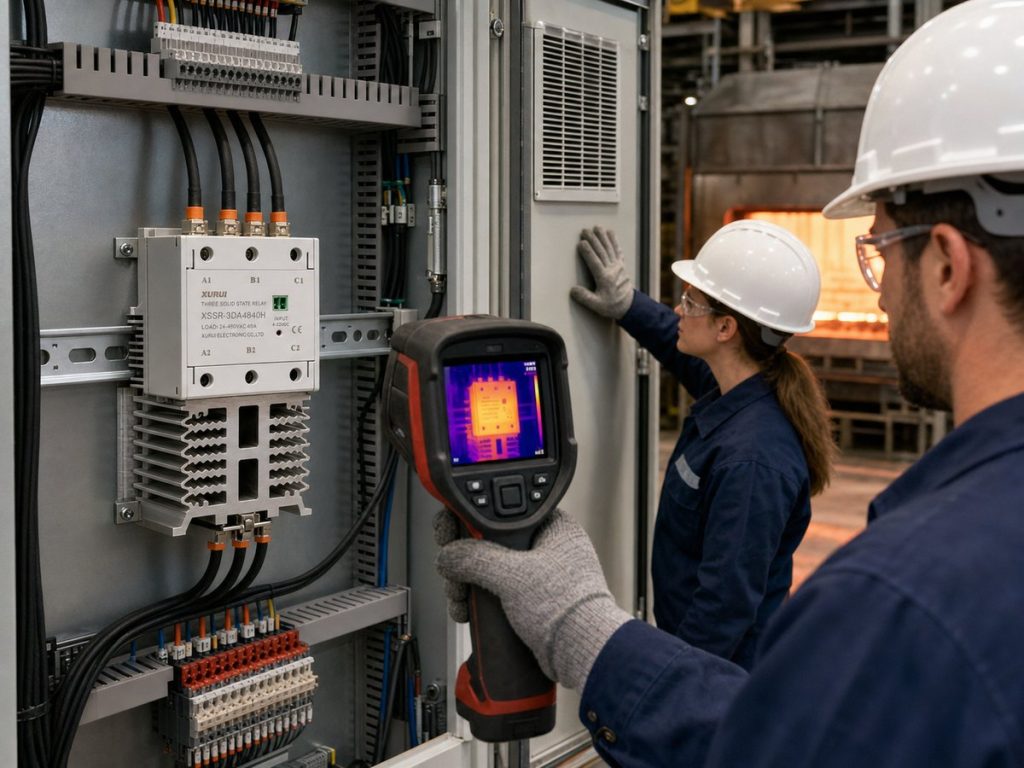
Coordinate four separate protection jobs:
- Branch protection for conductors and equipment
- A semiconductor fuse when the SSR data requires one
- Surge suppression matched to the supply and load
- An independent device that removes heater power after a dangerous control fault
A circuit breaker may protect wiring without clearing fast enough to protect the SSR output. Compare the fuse voltage, interrupting rating, total clearing I squared t, and available fault current with the SSR data. Effective SSR circuit protection coordinates these devices rather than treating one as a substitute for another.
How Do Furnace Manufacturers Source and Qualify an SSR Supplier?
Qualify the supplier through document review, sample testing, pilot production, and controlled volume supply. Apply the same furnace requirement at every stage.
Supplier Shortlisting and RFQ Comparison
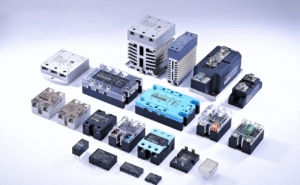
Shortlist suppliers that support the required phase, control method, thermal package, approvals, volume, and documentation. XURUI’s solid state relay product range separates single-phase, three-phase, DIN rail, monitoring, protection, and voltage-regulator families.
Send each supplier the same RFQ:
- Supply voltage, frequency, phase, and expected variation.
- Heater type, power, nominal current, cold resistance, and inrush.
- Zone count, duty cycle, switching period, and annual volume.
- Controller output, signal range, leakage, and polarity.
- Required switching method and maximum cabinet temperature.
- Heat sink, protection, approvals, traceability, and delivery terms.
Compare the full order code, tested conditions, accessories, lead time, change controls, and landed cost. Include the heat sink, fuse, cover, and required documents in the cost comparison.
Technical Documents and Certification Scope
Request the series datasheet, ordering-code key, drawing, wiring diagram, derating curves, heat sink data, surge curve, fuse recommendations, terminal torque, and certification documents.
Check minimum load current, off-state leakage, on-state voltage, switching time, surge current, dv/dt, insulation, and operating temperature. Confirm that every table and certificate covers the proposed order code. Mark missing model-level data as not verified.
Sample Testing and Pilot Production
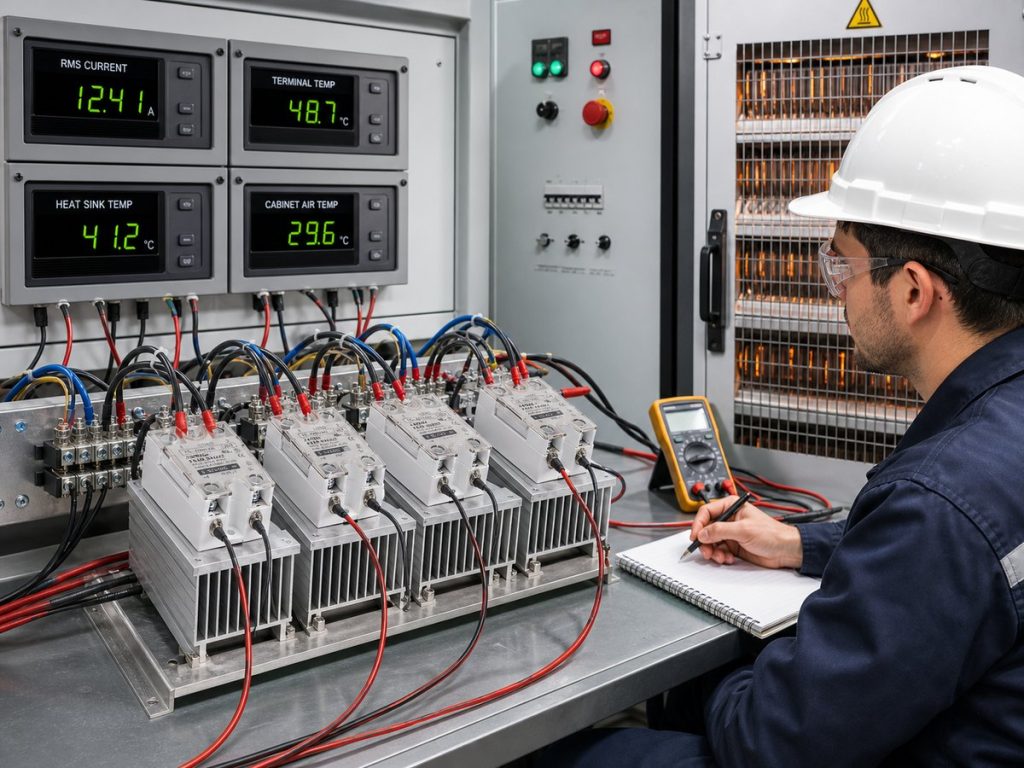
Test samples in a representative panel at the highest allowed supply voltage, lowest expected heater resistance, maximum cabinet temperature, densest mounting, and intended duty cycle. Include cold starts, repeated cycling, reduced airflow, sensor faults, and the designed shutdown response.
Measure RMS heater current, SSR voltage drop, terminal temperature, SSR base temperature, heat sink temperature, and cabinet air temperature. Use the released hardware, thermal interface, wire size, terminal torque, fuse, and heat sink during pilot production.
Production Quality and Supply Control
Place the manufacturer, order code, factory, critical documents, and approved accessories under one approval record. Define whether traceability stops at the incoming lot or extends to each furnace serial number.
Incoming inspection can check labels, terminals, dimensions, input operation, leakage, voltage drop, and sample thermal performance. XURUI uses project-based quotations, so the sourcing request should include forecast volume, batch size, documents, and delivery schedule.
How Can XURUI Support Furnace SSR Sourcing?
XURUI can narrow the SSR family after reviewing the heater circuit, controller output, cabinet conditions, approvals, and volume. The furnace manufacturer must still qualify the exact order code in the target design.
Candidate XURUI SSR Families by Furnace Requirement
Use these families for the initial shortlist. Confirm the exact voltage, current, trigger mode, heat sink, certificate, and ordering code.
| Furnace requirement | Candidate XURUI family | Main point to confirm |
|---|---|---|
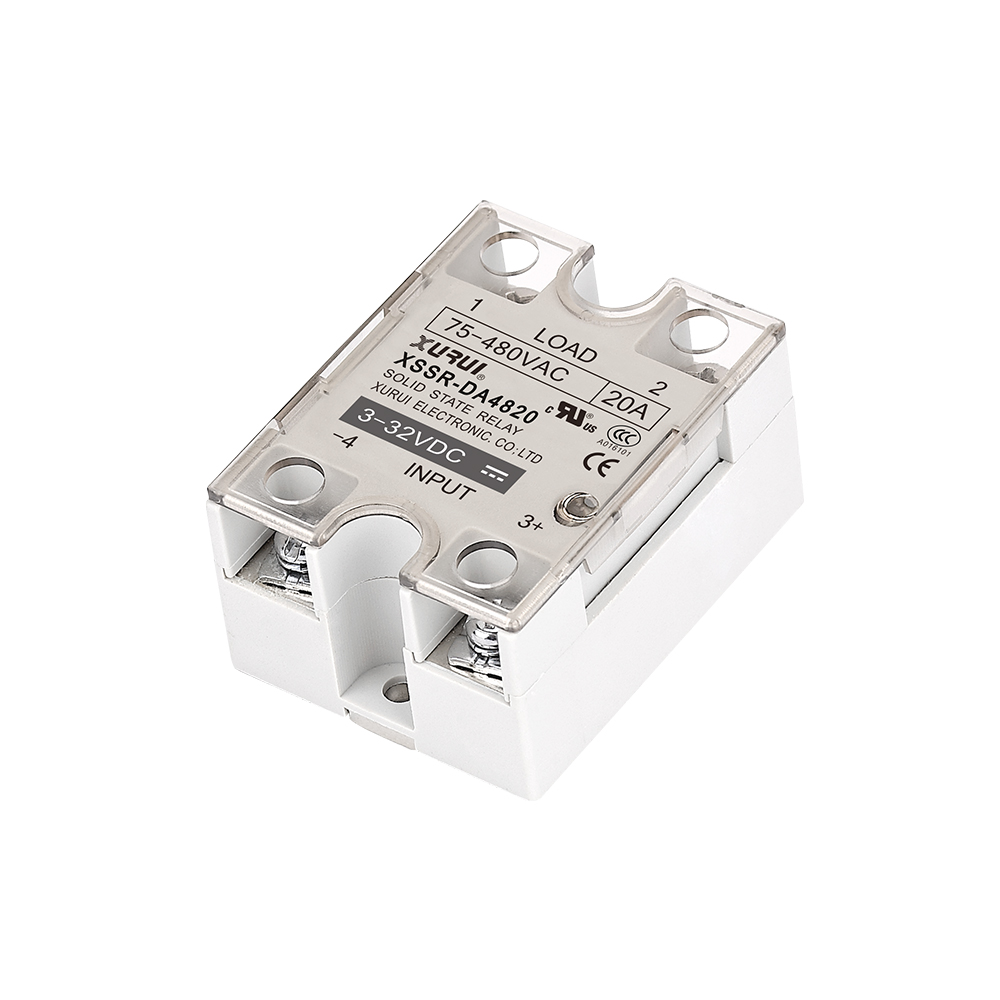
| Single-phase AC on and off control | XSSR-W series | Input, trigger mode, load range, heat sink, and fuse |
| Single-phase DIN rail installation | XSSR-H series | Derating, spacing, and integrated thermal package |
| Three-phase screw mounting | XSSR-3 W3 or XSSR-3 W4 | Circuit, heat sink, protection, and terminals |
| Three-phase DIN rail installation | XSSR-3H series | Cabinet temperature, phase protection, and order code |
| Higher-current AC load | XSSR-M1 through M6 | Load type, current margin, heat sink, and panel space |
| Single-phase phase-angle control | XSSVR-W1 or XSSVR-W2 | Control method, RMS current, harmonics, and cooling |
| Three-phase proportional control | XSSVR-3P series | Input, firing method, wiring, and thermal data |
| Monitoring or current protection | XSSR-JK W2 or XSSR-F W2 | Function logic, trip behavior, and reset method |
For an integrated three-phase layout, the XSSR-3H DIN rail three-phase SSR can enter the shortlist. Confirm phase-loss detection and the independent power-removal path.
Final Model and Ordering Code Confirmation
Send XURUI the circuit diagram, zone schedule, cabinet conditions, protection requirements, destination markets, forecast volume, and document list.
Request the full order code, datasheet revision, drawing, heat sink recommendation, protection data, terminal requirements, and applicable certification documents. Release the part only after document review and sample testing.
Frequently Asked Questions
Why Is Voltage Still Present When a Furnace SSR Is Turned Off?
An off SSR can pass a small leakage current through its semiconductor output and suppression circuit. A high-impedance meter may display voltage even when the current cannot power the heater normally. Treat the circuit as energized until a qualified person isolates and verifies it.
Can a Voltage Tester Alone Confirm That a Furnace SSR Has Failed?
No. A voltage reading cannot distinguish normal leakage, induced voltage, backfeed, a controller command, and a shorted SSR. A qualified technician should follow the model test procedure with a connected load and properly rated equipment.
Does a Furnace Need an Independent Cutoff if the SSR Fails Closed?
Use an independent cutoff when the risk assessment or applicable standard requires heater power removal after a dangerous fault. Because an SSR can fail shorted, a separate limit sensor and controller should operate a rated contactor or disconnecting device where uncontrolled heat creates a hazard.
Can One SSR Model Be Standardized Across Several Furnace Designs?
Yes, if the same order code passes the worst electrical, thermal, mechanical, certification, and fault conditions for every design. Document that approved design envelope before standardizing the part.
Should a Failed Furnace SSR Be Repaired or Replaced?
Replace a failed sealed SSR with the approved order code or a qualified substitute. Before restart, find the cause, such as overheating, poor thermal contact, a loose terminal, inadequate fuse coordination, overvoltage, inrush, or the wrong load type.
XURUI Engineering Team