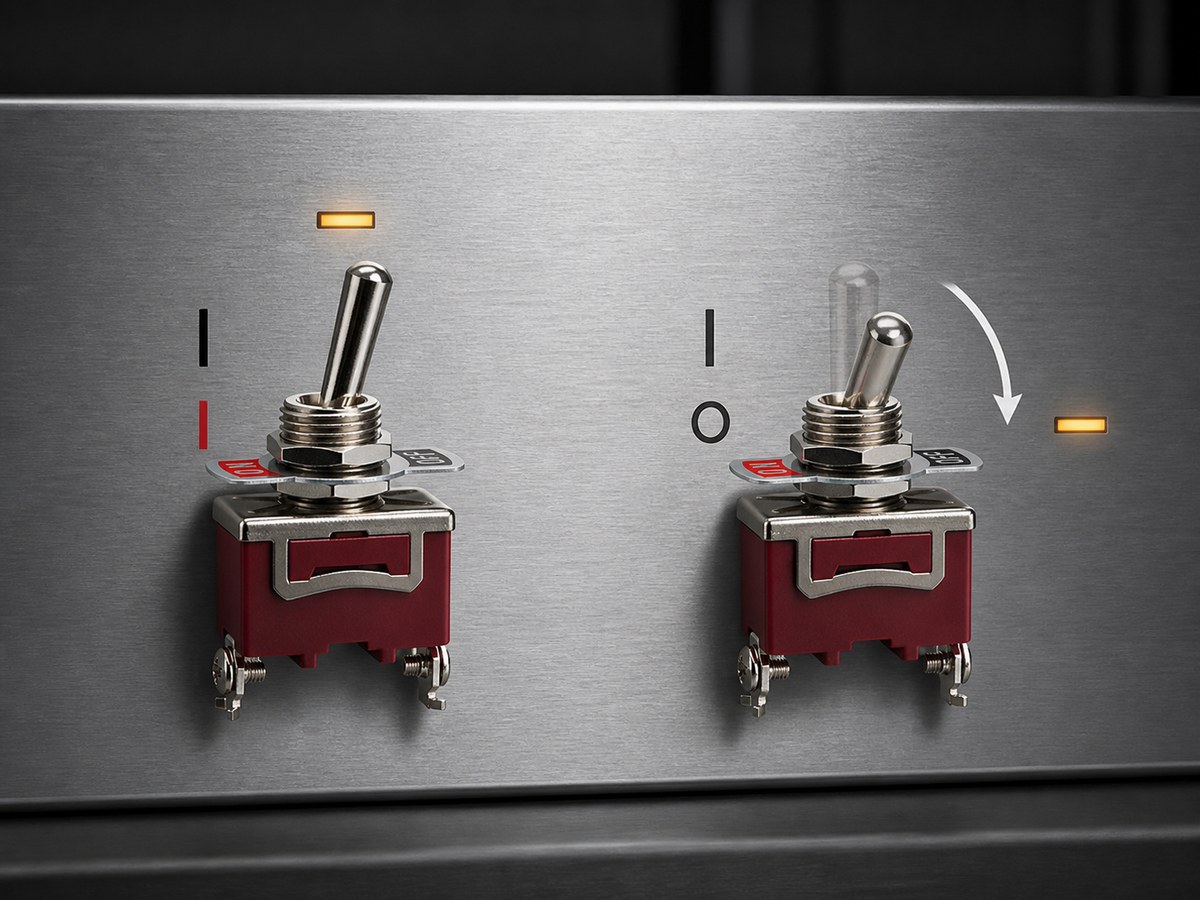
A maintained toggle switch holds the selected contact state after the operator releases the lever. A momentary toggle switch returns to its defined rest position after release. In an industrial control panel, that difference decides whether the switch supplies a held input or a temporary command.
Specify the action type before selecting poles, throws, ratings, terminals, or a panel cutout. A lever can match the required contact form and still create the wrong machine behavior when its return action is wrong.
How Do Maintained and Momentary Toggle Switches Work?
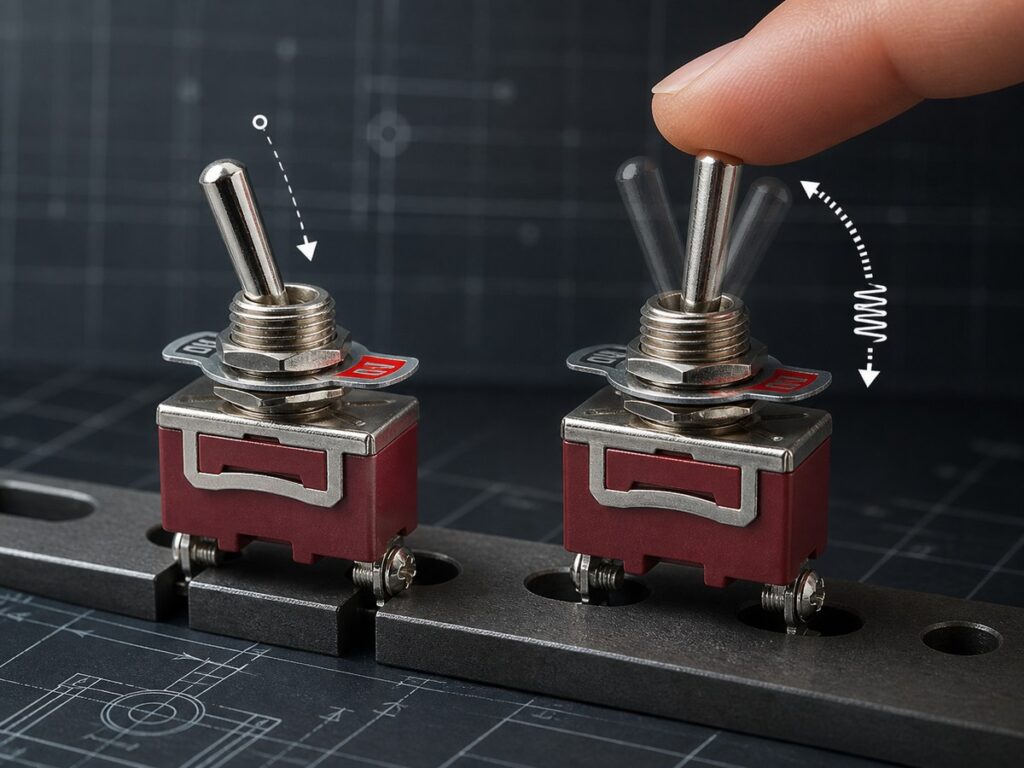
Maintained action leaves the lever and contacts in the selected state until the operator moves the lever again. Momentary action uses spring return, so the contact changes only while the operator holds the lever in its active direction. This difference changes operator input behavior, not the contact rating or pole count.
| Control Feature | Maintained Toggle Switch | Momentary Toggle Switch |
|---|---|---|
| Lever after release | Remains in the selected position | Returns to the specified rest position |
| Input at the contacts | Selected state remains | Temporary state exists while held |
| Typical panel job | A persistent enable, mode, or on/off state | A reset, test, jog, or temporary direction command |
| Control system check | Confirm the held state | Confirm the receiving circuit handles the intended input |
What Does Action Change in an Industrial Control Panel?
Action determines what the panel input does after the operator releases the lever. The control drawing should state whether a state remains present or the switch generates a temporary command.
Held Input State
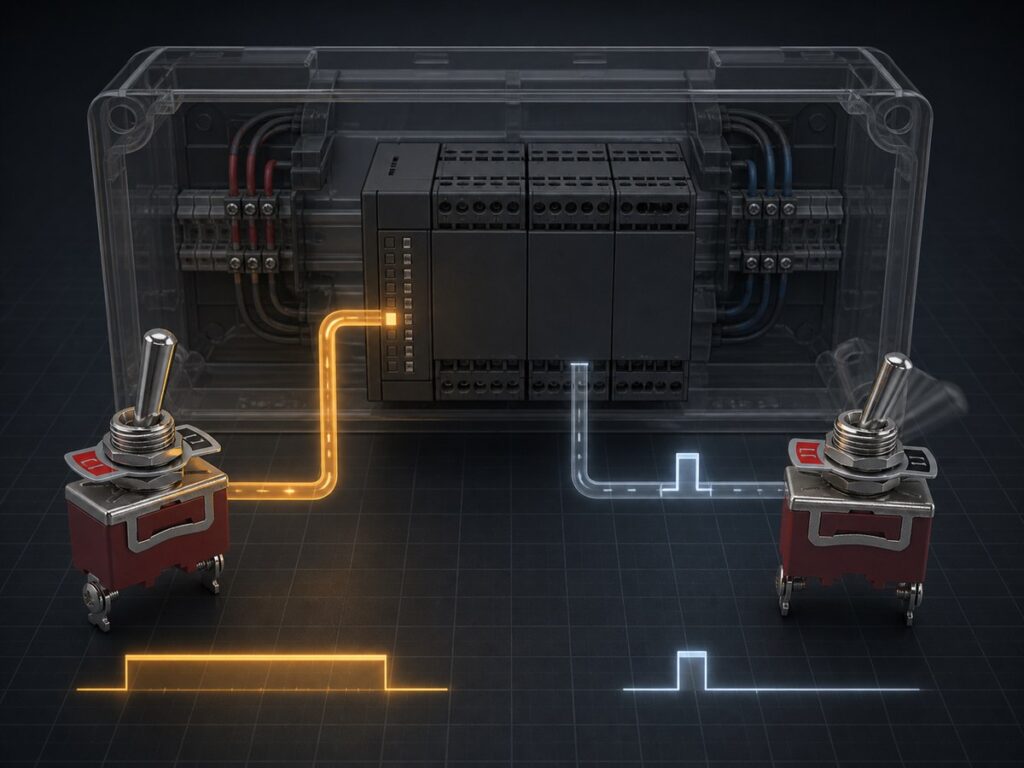
A maintained switch keeps a discrete input active or inactive until a person changes the lever again. This behavior can suit a function that needs to remain selected, provided the panel logic and operator label use the same meaning. The lever position also gives the operator a visible indication of the selected command.
Command Pulse
A momentary switch suits a command that should disappear when the operator lets go. A PLC, relay, or drive may retain the resulting command when the approved control logic calls for it, but the toggle itself does not hold the input. The momentary toggle selection guide covers the broader product checks after that action boundary is clear.
Why Are Action and Contact Form Separate Requirements?
Action, pole count, throw count, and position sequence describe different parts of the specification. A correct panel BOM states all of them because you cannot derive one from the others.
Pole and Throw
SPST, SPDT, DPST, and DPDT describe the number of circuit paths the switch can make or route. Those labels do not state whether the lever stays in its selected state or springs back. Use the toggle switch symbol guide to match the schematic contact paths to the real terminal arrangement.
Position Sequence
ON-OFF, ON-ON, and ON-OFF-ON describe available lever positions. The same position sequence can appear in maintained and auto reset versions, so state the return action separately. The Xurui Switch Catalog lists both hand reset and auto reset XT configurations.
What Should Panel Designers Verify?
The action choice is only the first check. The panel design should also confirm the control function, electrical duty, and physical interface for the exact switch configuration.
Logic and Labeling
Confirm the normal position, active position, contact state, and required behavior after release against the control drawing. A maintained lever where the circuit requires a pulse can leave an input active. A momentary lever where the circuit expects a held state can remove the input as soon as the operator lets go.
Electrical Duty
Match the exact part to the circuit voltage, current, load type, and any inrush requirement. If the catalog gives an AC rating only, obtain the documented DC rating for a DC application instead of transferring the AC value. The toggle switch buying guide covers the related rating, terminal, and operating-condition checks.
Panel Interface
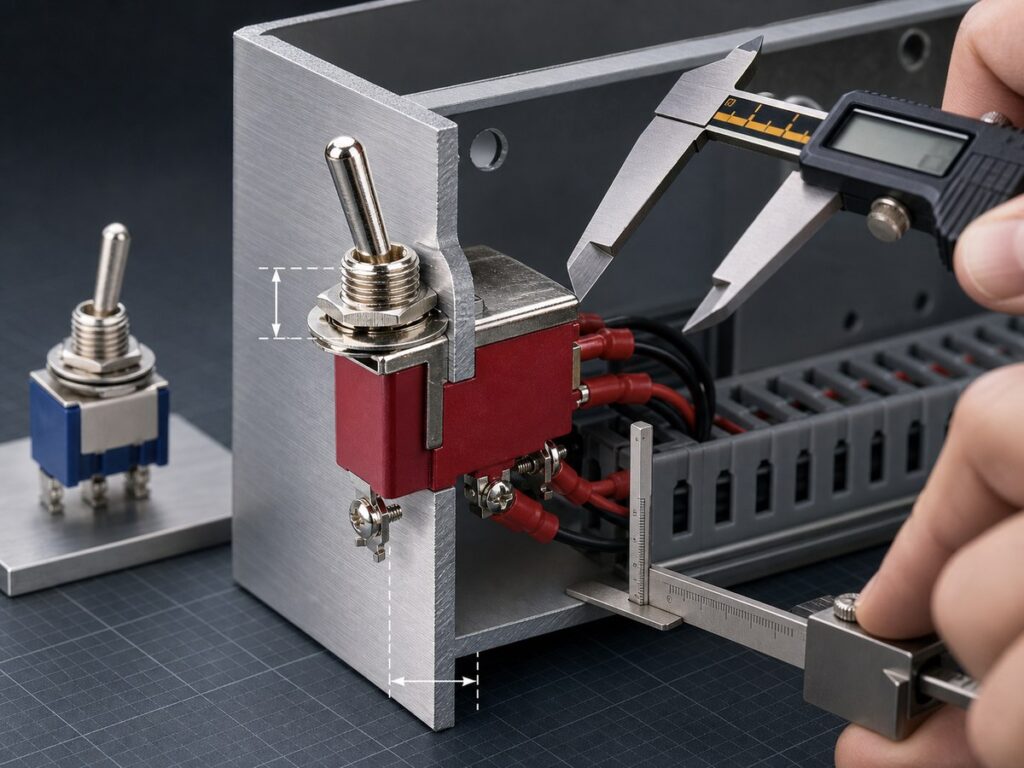
Verify the bushing size, panel thickness, rear clearance, terminal style, and environmental exposure before panel layout release. A fitting front panel hole does not confirm rear wiring clearance or a suitable sealing option. The exact part documentation should confirm any protective cap, boot, or IP rated configuration.
Where Do Xurui XT Toggle Switches Fit?
The Xurui XT Series includes hand reset and auto reset configurations. The official Switch Catalog shows maintained examples such as XT-11B with SPST ON-OFF action, plus auto reset examples such as XT-11BF with SPST (ON)-OFF action and XT-23BF with DPDT (ON)-OFF-(ON) action. Confirm the required configuration by part number and datasheet.
The XT Series Toggle Switch is the verified Xurui product family for this comparison. Its cataloged XT configurations use a 12 mm bushing, while the MTS sub-series uses a 6 mm bushing. Confirm MTS action separately when an RFQ requires momentary operation.
What Should an RFQ State?
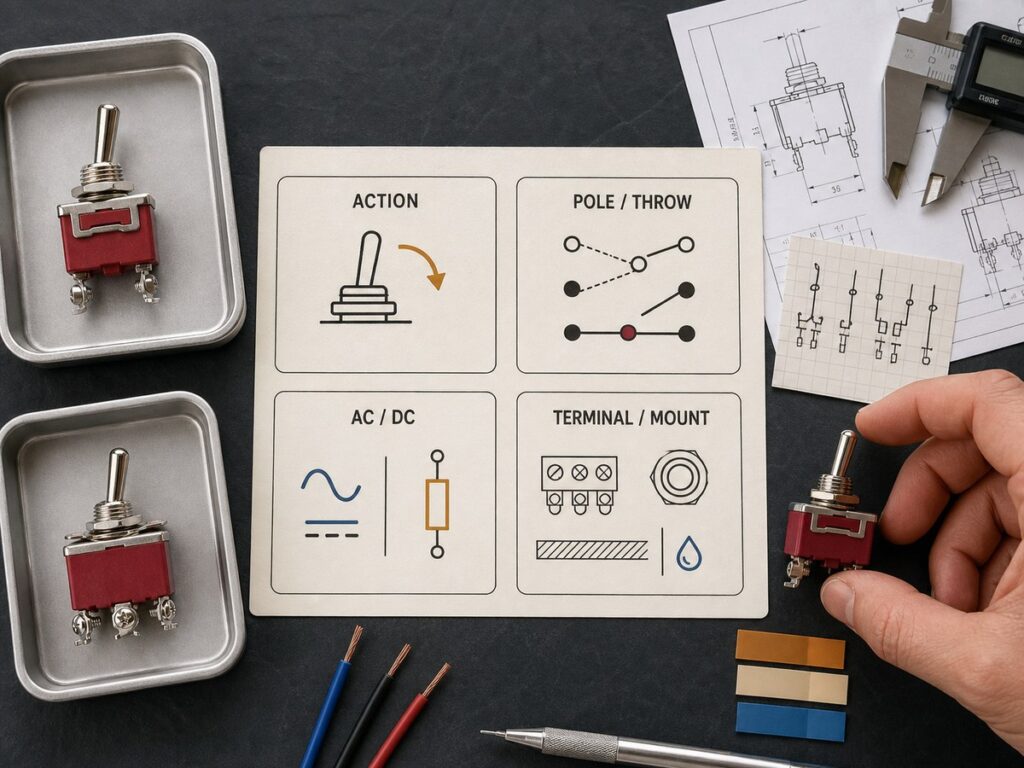
Once the action is clear, screen the toggle switch category against a complete requirement rather than a lever photo. State these items in the RFQ:
- Maintained or momentary action, including the required return direction.
- Pole and throw configuration with the required position sequence.
- Circuit voltage, current, load type, and documented AC or DC rating.
- Terminal style, bushing size, panel dimensions, and exposure conditions.
This list gives the supplier enough information to confirm a documented configuration or identify a missing requirement. For an XT series inquiry, Xurui Switch can confirm the applicable part code, rating, terminal form, and protection option from the actual application details.
FAQs
Does a Maintained Toggle Lever Position Confirm That the Machine Is Running?
No. A maintained toggle shows the selected switch position, but it does not confirm the state of a downstream PLC bit, relay, drive, or load. Use a separate feedback signal or status indicator when the panel needs to show actual equipment state.
What Should Happen When Power Returns With a Maintained Toggle Still Selected?
The response depends on the complete control circuit, not on switch action alone. Check the documented restart behavior before approving the circuit. When automatic or unintended restart could create a hazard, the machine’s risk controls should address that condition.
Can Wiring Turn a Maintained Toggle Into a Momentary Input?
No. Wiring changes how the contacts connect to the circuit, but it does not add the spring return that creates momentary action. Use a control circuit designed to interpret a maintained state as a temporary command, or specify a momentary switch when the input needs to return after release.
XURUI Engineering Team
Industrial SPST toggle switch on a control panel](https://xuruiswitch.com/wp-content/uploads/2026/09/spst-toggle-switch-industrial-control-cover-300x225.webp)
SPST toggle switch product on a clean electronics workbench](https://xuruiswitch.com/wp-content/uploads/2026/09/spst-toggle-switch-cover-300x225.webp)